
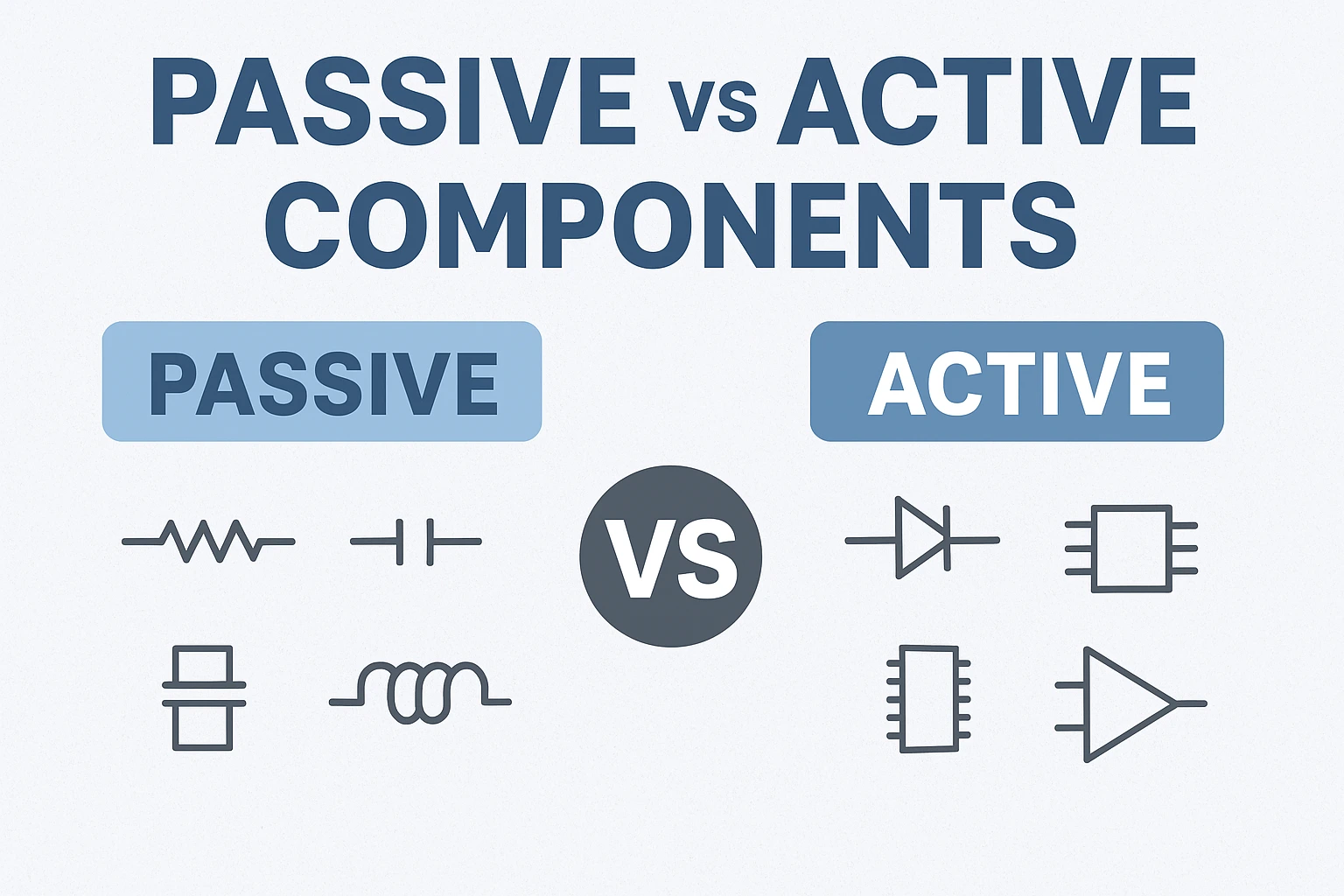
Passive vs Active Components: What’s the Difference and Why It Matters in Real-World Electronics
Why This Difference Actually Matters to You
Every time you plug in a charger, power up a machine, or switch on an industrial panel, you rely on dozens—sometimes thousands—of electronic components working quietly in the background. You may not see them, but they decide whether your system runs smoothly, wastes energy, or fails unexpectedly.
If you have ever asked yourself why a circuit behaves unpredictably, why voltage fluctuates, or why a power supply overheats, the answer often comes back to one core concept: passive vs active components.
Understanding this distinction is not just academic. It directly affects how you design circuits, select components, maintain power stability, and avoid costly mistakes. When you clearly understand how passive and active components interact—especially inside voltage regulators—you gain control over performance, efficiency, and reliability.
This article walks you through the topic step by step, using clear language, practical examples, and real engineering logic. By the end, you will not only understand the difference, but you will also know how to apply it confidently in real systems.
Table of Contents
What Are Electronic Components? The Foundation You Need
Before diving into passive vs. active components, you need a shared baseline.
Electronic components are the fundamental building blocks of any electrical or electronic system. They are designed to control, limit, store, convert, or amplify electrical energy. Without them, there is no signal processing, no power conversion, and no regulation.
You encounter electronic components in:
- Power supplies
- Control panels
- Consumer electronics
- Industrial automation
- Renewable energy systems
- Transmission and distribution equipment
What makes them powerful is not their individual function, but how they work together. This is where classification becomes essential.
Why Classification Matters in Circuit Design
When you design or analyze a circuit, you are not just connecting parts randomly. You are assigning roles.
Understanding passive vs active components allows you to:
- Predict circuit behavior accurately
- Control voltage and current safely
- Improve efficiency and reduce losses
- Extend equipment lifespan
- Meet electrical standards and safety requirements
Without this distinction, troubleshooting becomes guesswork, and design decisions become risky.
What Are Passive Components? A Clear Explanation
Definition of Passive Components
Passive components are electronic elements that do not generate energy and do not require an external power source to operate. They react to electrical signals rather than controlling them.
In simple terms, passive components can:
- Store energy
- Dissipate energy
- Transfer energy
But they cannot amplify or regulate a signal on their own.
Common Types of Passive Components
You will encounter these passive components in almost every circuit:
- Resistors – Limit current and divide voltage
- Capacitors – Store electrical energy temporarily
- Inductors – Store energy in a magnetic field
- Transformers – Transfer energy between circuits through electromagnetic induction
Each of these plays a specific supporting role in electrical systems.
Key Characteristics of Passive Components
Passive components share several defining traits:
- They do not need an external power supply
- They cannot increase signal strength
- Their behavior follows fundamental electrical laws
- They are highly reliable and stable over time
Because of their simplicity, passive components are often the backbone of long-lasting and rugged systems.
Where You Use Passive Components in Real Life
You rely on passive components more than you may realize. They are essential in:
- Filtering electrical noise
- Smoothing voltage ripple
- Limiting current in sensitive circuits
- Energy storage in power supplies
- Heat dissipation and protection
In power systems, passive components rarely work alone. They prepare, stabilize, and protect signals so that active components can perform precise control.
What Are Active Components? The Control Layer
Definition of Active Components
Active components are electronic elements that require an external power source to operate and can control or amplify electrical signals.
Unlike passive components, active components actively influence circuit behavior. They can switch, amplify, regulate, and process signals based on design intent.
Common Types of Active Components
Some of the most widely used active components include:
- Diodes – Control current direction
- Transistors – Amplify and switch signals
- Integrated Circuits (ICs) – Perform complex functions
- Voltage Regulators – Maintain stable output voltage
- Operational Amplifiers – Process analog signals
These components form the intelligence of modern electronics.
Key Characteristics of Active Components
Active components stand out because they:
- Require a power source to function
- Can amplify weak signals
- Enable switching and control logic
- Respond dynamically to input conditions
Without active components, modern electronics simply would not exist.
Where Active Components Are Essential
You depend on active components in:
- Power regulation systems
- Communication devices
- Control and automation systems
- Signal processing circuits
- Embedded and digital electronics
They transform raw electrical energy into usable, controlled outputs.
Passive vs Active Components: The Core Differences
To truly understand passive vs active components, it helps to compare them directly.
| Feature | Passive Components | Active Components |
|---|---|---|
| External Power Required | No | Yes |
| Signal Amplification | No | Yes |
| Control Capability | Limited | High |
| Complexity | Low | Medium to High |
| Typical Role | Support and stabilization | Regulation and control |
This difference is not about importance—both are essential. It is about function and responsibility within a system.
How Passive and Active Components Work Together
No practical circuit uses only one type.
Passive components shape and protect signals. Active components control and regulate them. When properly combined, they create systems that are stable, efficient, and predictable.
This relationship becomes especially clear when you examine voltage regulation.
How Voltage Regulators Maintain Power Stability
What Is a Voltage Regulator?
A voltage regulator is an active component designed to maintain a constant output voltage, even when:
- Input voltage changes
- Load conditions vary
- Temperature fluctuates
If you care about system reliability, voltage regulation is not optional—it is essential.
Why Voltage Stability Matters to You
Unstable voltage can cause:
- Component overheating
- Data corruption
- Reduced equipment lifespan
- Unexpected shutdowns
Voltage regulators protect your system by enforcing electrical discipline.
The Active Role Inside Voltage Regulators
Active components inside voltage regulators perform tasks such as:
- Monitoring output voltage
- Comparing it to a reference value
- Adjusting current flow dynamically
- Compensating for load changes
This closed-loop control is impossible without active elements like transistors and IC controllers.
The Supporting Role of Passive Components
Passive components are just as critical inside voltage regulators. They handle tasks such as:
- Filtering noise with capacitors
- Storing energy with inductors
- Stabilizing feedback paths with resistors
- Reducing voltage ripple
Without these passive elements, active control would become unstable or noisy.
Typical Components Inside a Voltage Regulator
| Component | Type | Function |
|---|---|---|
| Transistor | Active | Controls voltage and current |
| Controller IC | Active | Manages regulation logic |
| Capacitor | Passive | Smooths output voltage |
| Inductor | Passive | Stores and transfers energy |
| Resistor | Passive | Sets feedback and limits current |
This balance between passive and active components is what maintains power stability.
Why Passive vs Active Components Matter for Power Design
When you design or maintain electrical systems, the distinction directly affects outcomes.
System Reliability
Proper use of passive components reduces stress on active components. This leads to:
- Fewer failures
- Longer service life
- Improved thermal performance
Efficiency and Energy Loss
Passive components introduce losses, but active components control them. A well-designed balance:
- Minimizes wasted energy
- Improves overall efficiency
- Reduces operating costs
Compliance and Safety
Standards often assume correct use of both component types. Incorrect selection can lead to:
- Non-compliance
- Safety hazards
- Equipment rejection
Understanding passive vs. active components helps you meet technical and regulatory expectations.
Common Mistakes You Should Avoid
Even experienced professionals make these errors:
- Expecting passive components to regulate voltage
- Underrating capacitors or inductors
- Ignoring thermal limits of active components
- Poor grounding and feedback design
Most of these mistakes trace back to misunderstanding component roles.
Frequently Asked Questions About Passive vs Active Components
What is the main difference between passive vs active components?
The main difference is that active components require an external power source and can control or amplify signals, while passive components cannot.
Can passive components regulate voltage on their own?
No. Passive components can smooth and filter voltage, but regulation requires active control.
Why are voltage regulators considered active components?
Because they rely on powered control circuitry to maintain a stable output voltage under varying conditions.
How do passive vs active components work together in power supplies?
Passive components stabilize and filter energy, while active components control voltage and current precisely.
Are voltage regulators necessary in all circuits?
Any circuit requiring stable voltage under varying conditions benefits from a voltage regulator.
Conclusion: Take Control of Your Power Design
Understanding passive vs. active components changes how you approach electronics. You stop guessing and start designing with intent. You know which components support, which control, and how they work together to maintain power stability.
If you want reliable systems, efficient power supplies, and professional-grade results, this knowledge is not optional—it is foundational.