
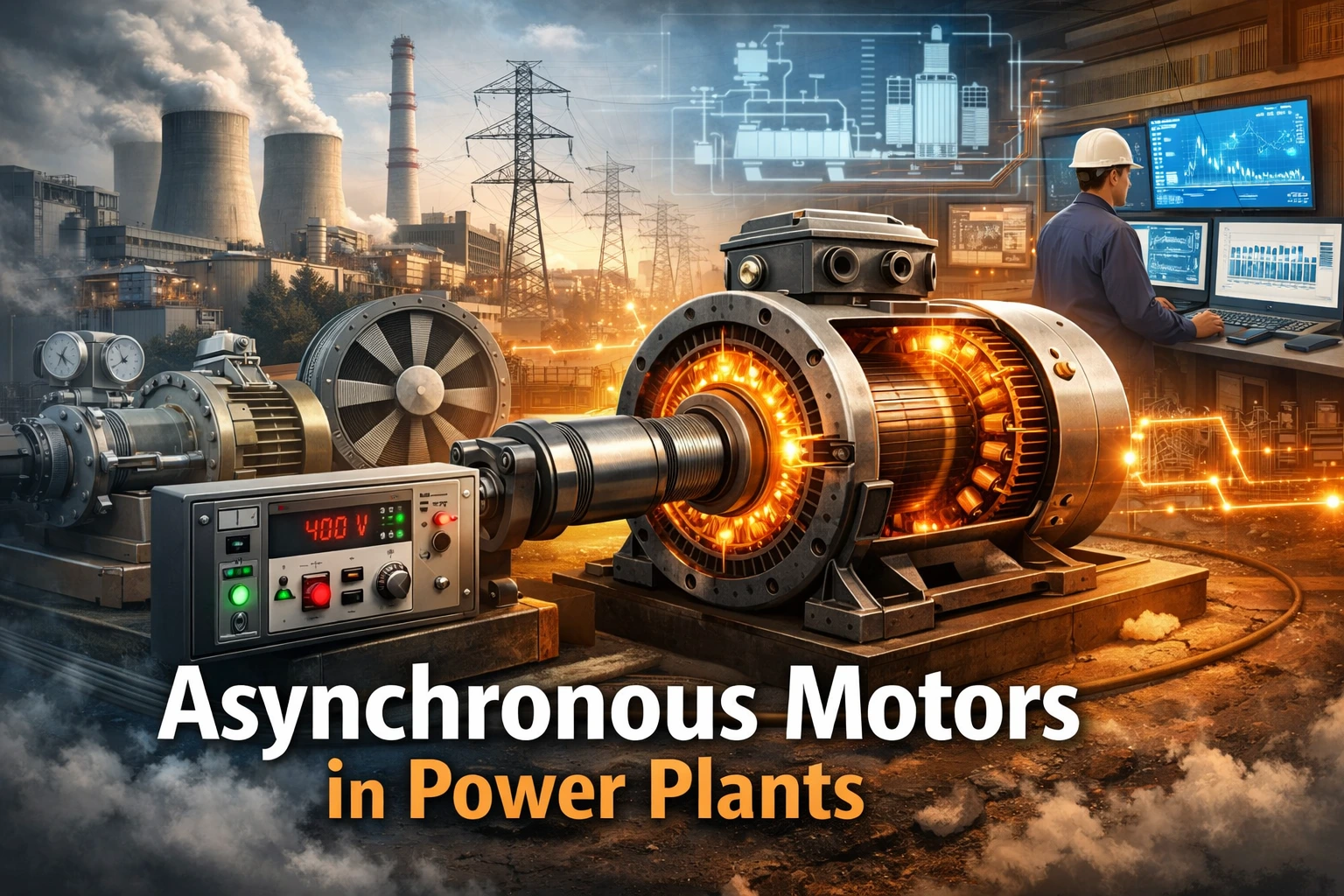
What Is the Role of an Asynchronous Motor in Power Plants? Understanding Stability, Control, and Reliability
Electric power plants are designed to operate without pause. Every second of downtime carries technical, financial, and social consequences. While turbines and generators often take center stage, they cannot function alone. Behind the scenes, a network of machines works continuously to support generation, cooling, fuel handling, and safety systems.
Among these machines, the asynchronous motor plays a critical and often underestimated role.
When you look closely at how power plants maintain operational continuity and voltage stability, you quickly realize that asynchronous motors are not optional components. They are essential. Understanding their function helps you grasp how modern power plants achieve efficiency, reliability, and long-term stability under fluctuating electrical and mechanical conditions.
Table of Contents
Understanding the Asynchronous Motor
What Is an Asynchronous Motor?
An asynchronous motor, commonly referred to as an induction motor, is an AC motor where the rotor does not rotate at the same speed as the stator’s magnetic field. This speed difference—known as slip—is not a flaw. It is the core principle that allows torque to develop.
In practical terms, this means you are dealing with a motor that:
- Adjusts its speed automatically based on load
- Does not require external excitation
- Can tolerate harsh operating conditions
In power plants, these characteristics are invaluable.
Basic Working Principle of an Asynchronous Motor
To understand why asynchronous motors are so widely used in power plants, you need to understand how they operate.
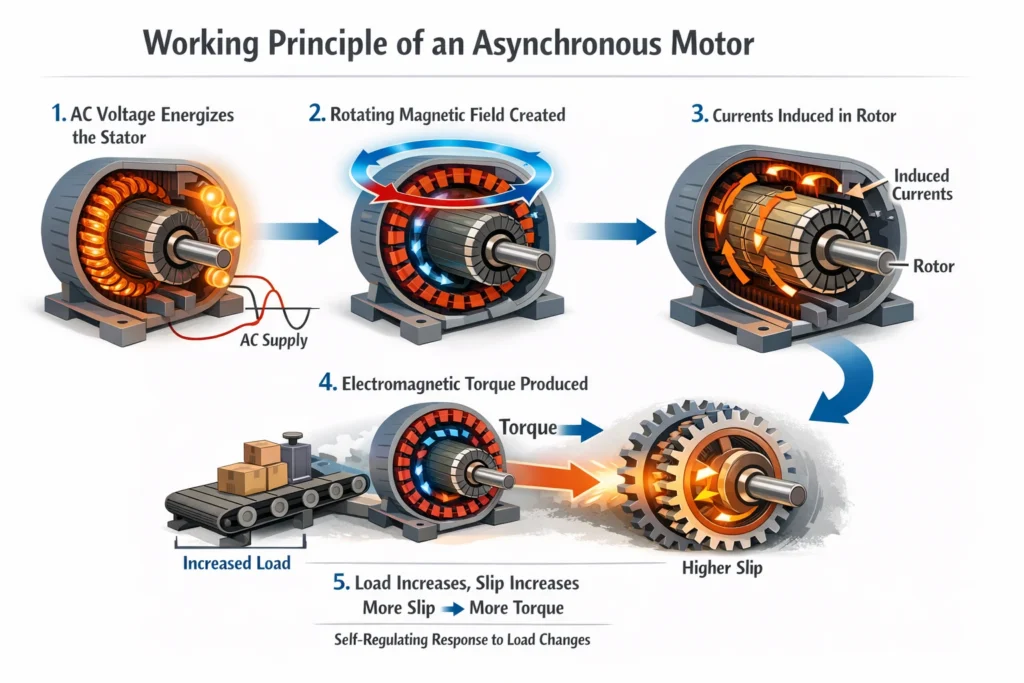
When you energize the stator with AC voltage:
- A rotating magnetic field is produced
- This field cuts across the rotor conductors
- Current is induced in the rotor
- Electromagnetic interaction creates torque
Because torque depends on slip, the motor naturally responds to load changes. When load increases, slip increases slightly, generating more torque. This self-regulating behavior is one of the main reasons asynchronous motors are trusted in critical power plant systems.
Why Asynchronous Motors Are Essential in Power Plants
The Role of Asynchronous Motors in Power Generation Facilities
Power plants rely on hundreds—sometimes thousands—of auxiliary systems. Most of these systems are driven by asynchronous motors.
You will typically find asynchronous motors operating:
- Boiler feedwater pumps
- Cooling tower fans
- Circulating water pumps
- Induced and forced draft fans
- Fuel conveyor belts
- Ash handling systems
- Lubrication oil pumps
These systems must operate continuously, often under variable loads. Asynchronous motors excel in this environment because they require minimal supervision and maintain stable operation without complex control mechanisms.
Why Power Plants Prefer Asynchronous Motors
From an engineering perspective, asynchronous motors offer advantages that align perfectly with power plant requirements:
- Mechanical robustness
Their simple construction reduces failure points. - Low maintenance demands
No brushes, no slip rings in squirrel-cage designs. - High reliability under continuous duty
Ideal for 24/7 operation. - Cost efficiency
Lower initial and lifecycle costs compared to synchronous motors. - Tolerance to electrical disturbances
Short voltage dips do not immediately cause shutdowns.
When reliability outweighs precision speed control, asynchronous motors become the logical choice.
How Asynchronous Motors Contribute to Power Stability
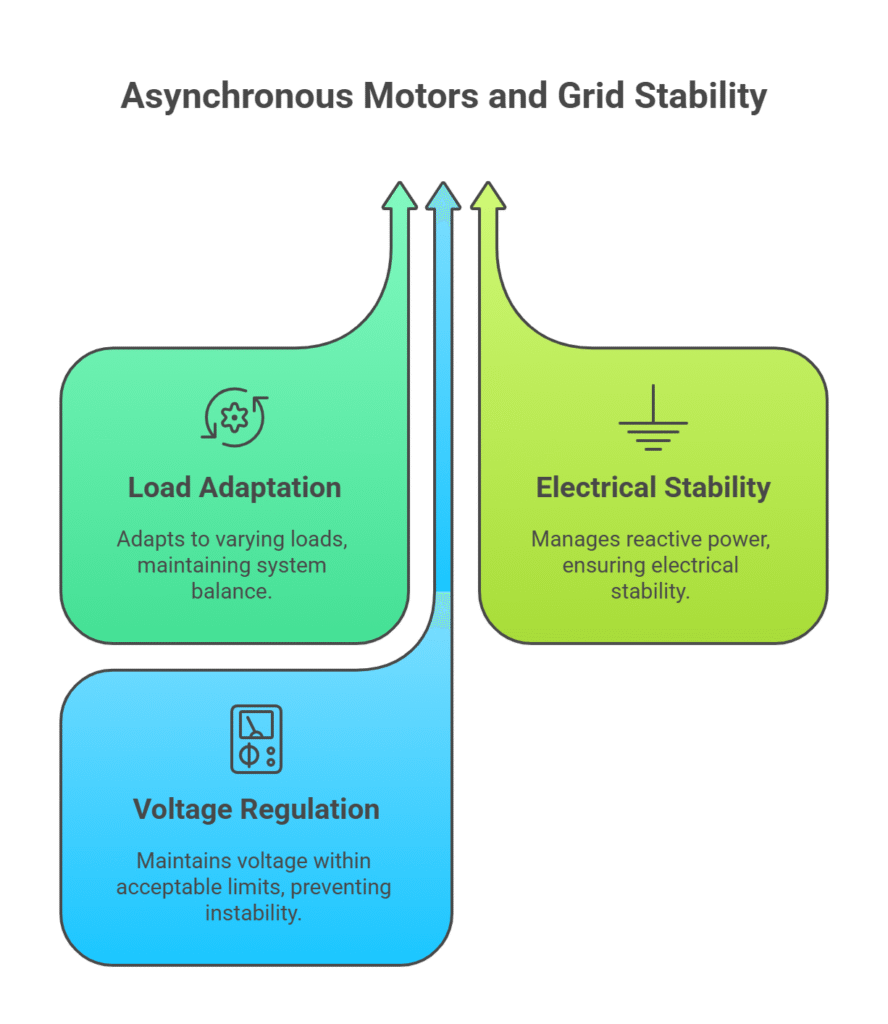
Load Adaptation and System Balance
Power plant auxiliary loads are rarely constant. Pump flow requirements change, fans respond to combustion conditions, and cooling demands fluctuate with ambient temperature.
An asynchronous motor automatically adapts to these variations:
- Increased load results in increased slip
- Increased slip produces higher torque
- System balance is maintained without external intervention
This behavior helps prevent mechanical stress and electrical instability, contributing indirectly to overall grid reliability.
Electrical Stability and Motor Behavior
Asynchronous motors also influence electrical stability. While they draw reactive power, their predictable behavior allows engineers to design compensation systems effectively.
In well-designed plants:
- Reactive power demand is managed
- Voltage profiles remain within acceptable limits
- Motor operation does not destabilize the system
This coordination is closely linked to voltage regulation strategies.
How Voltage Regulators Maintain Power Stability
What Voltage Regulators Do in Power Plants
Voltage regulation is critical in power generation. If voltage fluctuates beyond acceptable limits:
- Motors overheat
- Insulation degrades
- Torque capability drops
- System losses increase
Voltage regulators ensure that electrical equipment—including asynchronous motors—receives stable voltage regardless of load changes or grid disturbances.
Interaction Between Voltage Regulators and Asynchronous Motors
Asynchronous motors are sensitive to voltage variations:
- A voltage drop reduces torque significantly
- Overvoltage increases magnetic flux and losses
Voltage regulators protect motors by:
- Maintaining consistent stator voltage
- Limiting inrush current effects
- Preventing prolonged undervoltage conditions
This coordination extends motor lifespan and preserves system efficiency.
Common Voltage Regulation Methods in Power Plants
Power plants employ multiple voltage control technologies:
- Automatic Voltage Regulators (AVR)
Used primarily on generators to stabilize output voltage. - On-Load Tap Changers (OLTC)
Adjust transformer ratios under load conditions. - Static VAR Compensators (SVC)
Control reactive power dynamically. - Power Electronic Controllers
Used in modern plants for precise voltage and reactive power control.
Each method supports asynchronous motor performance indirectly by stabilizing the electrical environment.
Asynchronous Motors and Energy Efficiency
Efficiency Classes and Standards
Modern power plants prioritize efficiency. Asynchronous motors are manufactured under international efficiency standards such as:
- IE2 (High efficiency)
- IE3 (Premium efficiency)
- IE4 (Super premium efficiency)
Selecting higher efficiency motors reduces:
- Internal losses
- Heat generation
- Auxiliary power consumption
Over time, these savings become substantial.
Impact on Overall Plant Efficiency
Although auxiliary motors do not generate power, they consume a significant portion of plant output. Improving asynchronous motor efficiency directly improves net plant efficiency.
You benefit from:
- Lower fuel consumption
- Reduced emissions
- Improved operational margins
Performance Comparison: Asynchronous vs. Synchronous Motors
| Parameter | Asynchronous Motor | Synchronous Motor |
|---|---|---|
| Starting Complexity | Simple | Complex |
| Maintenance | Low | High |
| Cost | Lower | Higher |
| Load Adaptation | Automatic | Limited |
| Suitability for Auxiliaries | Excellent | Moderate |
For most auxiliary systems, asynchronous motors offer the best balance between performance and reliability.
Safety, Protection, and Compliance
Standards Governing Asynchronous Motors
Asynchronous motors in power plants must comply with international standards, including:
- IEC 60034 (Rotating electrical machines)
- Insulation class requirements
- Thermal performance limits
Compliance ensures safe and predictable operation.
Protection Systems Used with Asynchronous Motors
To protect motors and connected systems, power plants implement:
- Overcurrent protection
- Thermal overload relays
- Undervoltage protection
- Earth fault detection
- Variable Frequency Drive (VFD) monitoring
These protections minimize downtime and prevent catastrophic failures.
Challenges of Using Asynchronous Motors in Power Plants
Common Operational Issues
Despite their reliability, asynchronous motors face challenges:
- Voltage fluctuations
- Harmonics from power electronics
- Bearing wear due to continuous operation
- High starting currents
Ignoring these factors shortens motor life and affects plant reliability.
Engineering Solutions and Best Practices
To overcome these challenges, engineers apply:
- Proper motor sizing
- Soft starters or VFDs
- Regular insulation testing
- Predictive maintenance strategies
- Reactive power compensation
These measures improve performance while reducing lifecycle costs.
Future Role of Asynchronous Motors in Power Plants
As power plants modernize and integrate digital monitoring, asynchronous motors remain relevant. Advanced diagnostics, smart protection systems, and energy-efficient designs ensure they continue supporting generation systems effectively.
You are likely to see:
- Wider use of VFD-controlled motors
- Integration with plant automation systems
- Improved efficiency standards
The technology evolves, but the core principle remains unchanged.
Frequently Asked Questions (FAQ)
What is the main role of an asynchronous motor in power plants?
You rely on asynchronous motors to drive auxiliary systems that keep the plant operating safely and continuously.
Why are asynchronous motors preferred in power plants?
They are durable, cost-effective, easy to maintain, and adaptable to load variations.
How does voltage regulation affect asynchronous motor performance?
Stable voltage ensures proper torque, limits overheating, and extends motor lifespan.
Can asynchronous motors handle voltage fluctuations?
They can tolerate short disturbances, but prolonged instability reduces efficiency and reliability.

Conclusion
When you look beyond turbines and generators, you discover that the asynchronous motor is one of the most important contributors to power plant reliability. Its ability to adapt to load changes, operate continuously, and cooperate with voltage regulation systems makes it indispensable.
Understanding how asynchronous motors support power stability allows you to make better design, maintenance, and operational decisions. Whether you are an engineer, technician, or energy professional, this knowledge strengthens your ability to build safer, more efficient power systems.
Call to Action
If you want deeper technical guides, real-world diagrams, efficiency calculators, or professional training content on electrical machines and power systems, explore more resources on zoneleec.com.
Share this article with your engineering network, and let us know which topic you want explained next—your feedback drives our next in-depth guide.