
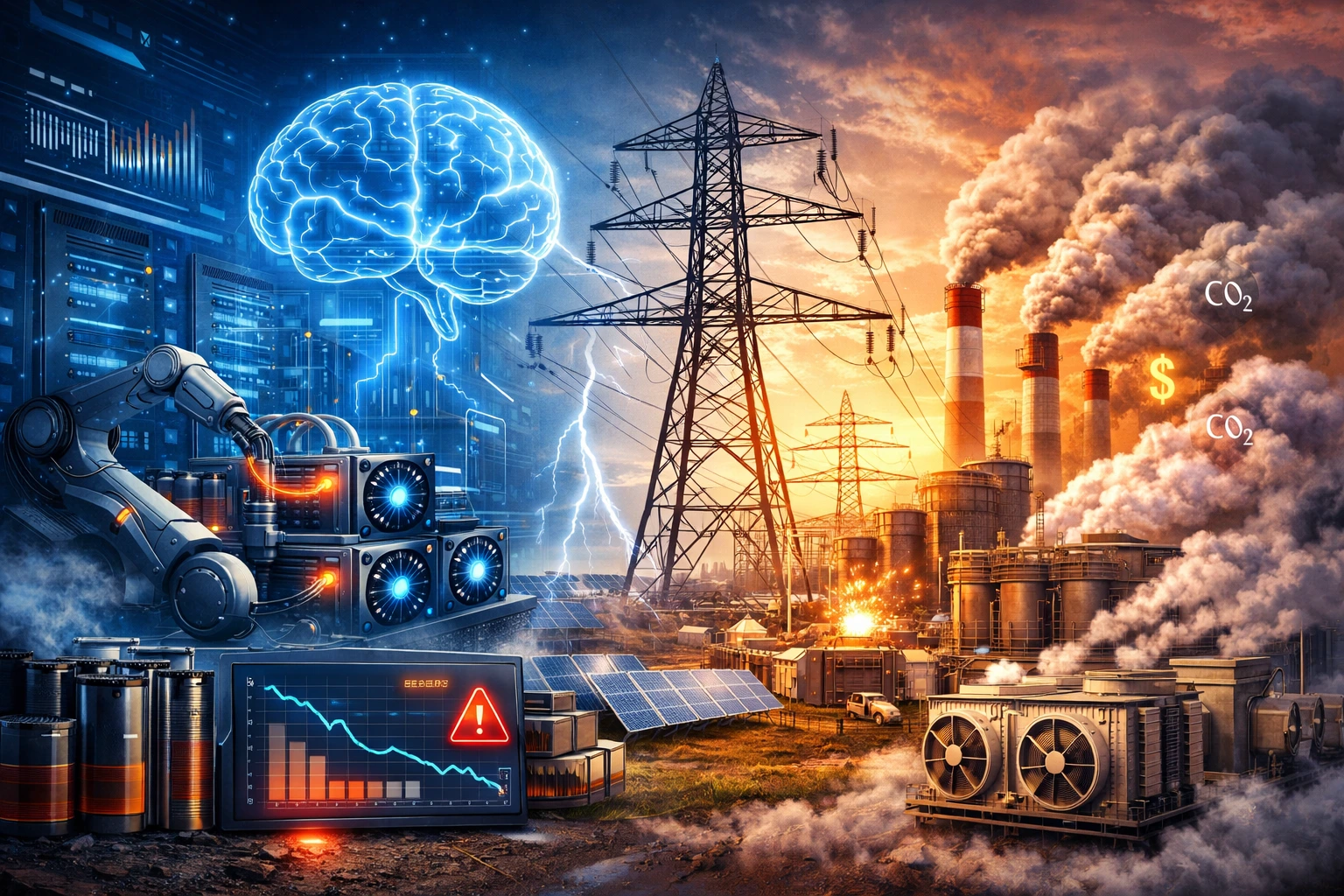
Challenges of Artificial Intelligence in Electricity Consumption in 2026: What You Need to Know
Why AI’s Growing Power Hunger Should Concern You
You probably interact with artificial intelligence dozens of times a day—often without realizing it. From search engines and recommendation systems to smart assistants and industrial automation, AI has quietly become part of your routine. What you do not see is what happens behind the scenes: massive servers running nonstop, cooling systems working around the clock, and electrical networks pushed closer to their limits than ever before.
In 2026, artificial intelligence is no longer just a software issue. It is an electricity issue.
If you work in engineering, energy, construction, or even digital business, the challenges of artificial intelligence in electricity consumption are no longer theoretical. They affect grid stability, electricity prices, sustainability goals, and long-term infrastructure planning. This article helps you understand those challenges clearly—and shows how power systems are trying to keep up.
Table of Contents
Understanding Artificial Intelligence Electricity Consumption in 2026
Before you can evaluate the challenges, you need to understand why AI has become such a demanding consumer of electricity.
AI Is No Longer Lightweight Software
In earlier years, most software ran efficiently on standard CPUs. In 2026, AI relies on:
- High-performance GPUs and TPUs
- Parallel computing architectures
- Continuous learning and retraining
- Always-on inference systems
Each of these elements increases power demand dramatically. When you scale them across millions of users and thousands of data centers, electricity consumption grows faster than traditional forecasts ever expected.
Where the Power Is Actually Used
AI electricity consumption does not come from a single source. It is distributed across multiple layers:
- Training phase: Extremely energy-intensive, often running for weeks
- Inference phase: Continuous demand as AI serves users in real time
- Cooling systems: Often equal to or greater than computing load
- Supporting infrastructure: Networking, storage, and redundancy systems
This layered demand makes AI different from conventional industrial loads—and much harder for utilities to manage.
The Biggest Challenges of Artificial Intelligence in Electricity Consumption?
The challenges of artificial intelligence in electricity consumption are not limited to higher bills. They affect how electrical systems operate at every level.
Explosive Growth of Data Center Power Demand
Why Data Centers Are the Core Problem
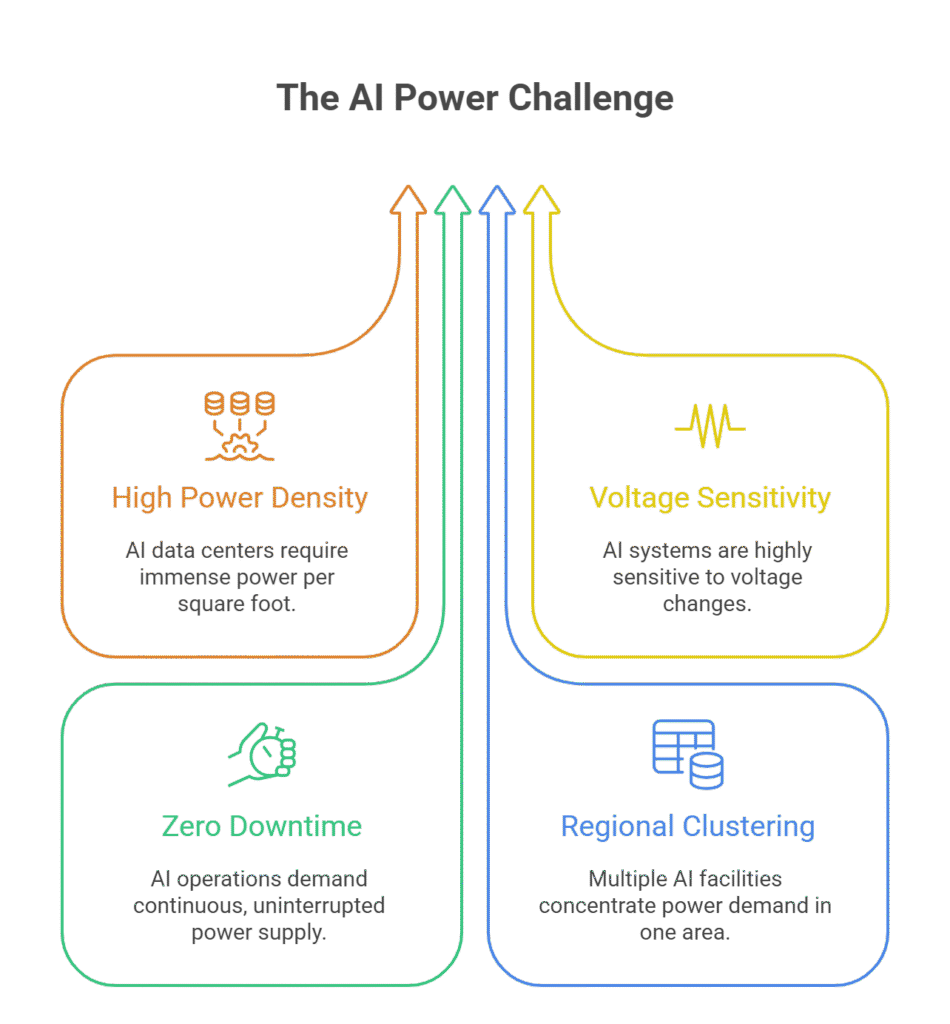
In 2026, data centers are the heart of AI operations. Unlike traditional commercial buildings, AI-focused data centers behave like industrial facilities with:
- Extremely high power density
- Minimal tolerance for voltage fluctuations
- Near-zero downtime requirements
A single large AI data center can consume as much electricity as a medium-sized city.
The Local Grid Impact You Cannot Ignore
When multiple AI facilities connect to the same region, you begin to see:
- Overloaded transformers
- Thermal stress on underground cables
- Congested feeders
- Delayed grid connection approvals
Utilities are often forced to upgrade infrastructure faster than planned, driving up costs for everyone connected to the same network.
Grid Instability Caused by AI Load Variability
AI Does Not Behave Like Traditional Loads
Factories, lighting, and residential loads follow predictable patterns. AI does not.
AI workloads can spike suddenly due to:
- Model retraining
- Viral user demand
- Emergency system scaling
- Market-driven computation bursts
These abrupt changes create serious challenges for grid operators.
How Instability Shows Up in Real Life
If you are an electrician or engineer, you may already recognize the symptoms:
- Voltage dips during peak AI activity
- Frequency deviations at substations
- Unexpected breaker trips
- Increased transformer noise and heat
These are not minor inconveniences. Over time, they shorten equipment lifespan and increase failure rates.
Renewable Energy Mismatch with AI Power Needs
Why Green Energy Alone Is Not Enough
You may hear that AI companies are “powered by renewable energy.” In practice, the situation is more complicated.
AI systems require:
- Continuous, uninterrupted power
- High reliability
- Tight voltage and frequency control
Solar and wind generation, while essential, remain intermittent. Without sufficient storage, they cannot fully support constant AI loads.
The Storage Gap Problem
Energy storage solutions exist, but in 2026:
- Battery costs remain high
- Large-scale storage deployment is slow
- Lifespan and recycling issues persist
This mismatch forces grids to rely on backup generation, often fossil-based, undermining sustainability claims.
Carbon Footprint and Sustainability Pressure
The Hidden Emissions Behind “Smart” Systems
While AI improves efficiency in many industries, its own carbon footprint continues to raise concerns.
Electricity for AI often comes from mixed energy sources. This means:
- Indirect emissions remain significant
- Carbon neutrality claims vary widely
- Regulatory scrutiny is increasing
As sustainability reporting becomes stricter, AI electricity consumption is moving from a technical issue to a compliance issue.
How Voltage Regulators Maintain Power Stability Under AI Loads
One of the most critical technical responses to AI-driven demand is advanced voltage regulation.
Why Voltage Regulation Is Critical for AI Infrastructure
AI hardware is extremely sensitive to power quality. Even small deviations can cause:
- Server reboots
- Data corruption
- Performance throttling
- Hardware degradation
Voltage regulators act as the first line of defense between unstable grids and sensitive AI systems.
Types of Voltage Regulators Used in AI-Powered Facilities
On-Load Tap Changers (OLTC)
You often find OLTCs in substations supplying data centers. They adjust transformer tap positions under load, helping maintain voltage within acceptable limits during demand fluctuations.
Static Voltage Regulators
These electronic systems respond far faster than mechanical devices. They are commonly installed inside data centers to protect critical equipment from short-term disturbances.
AI-Assisted Smart Regulators
In 2026, voltage regulation itself is becoming smarter. Predictive algorithms analyze load trends and adjust voltage proactively, rather than reactively.
Limits of Voltage Regulation in High AI Penetration Grids
Voltage regulators are essential—but they are not a cure-all.
They cannot:
- Create additional generation capacity
- Eliminate peak demand issues
- Replace long-term grid upgrades
When AI demand exceeds infrastructure limits, voltage control alone is no longer sufficient.
Infrastructure and Cost Challenges Linked to AI Electricity Consumption
Why Someone Always Pays the Price
Grid upgrades are expensive. When AI demand accelerates faster than planning cycles, costs increase sharply.
You may see:
- Higher connection fees for new projects
- Increased electricity tariffs
- Delayed infrastructure timelines
Even consumers who never use AI directly may feel the financial impact.
The Skilled Workforce Shortage
Modern grids require professionals who understand both power systems and digital technologies. In many regions, that talent is scarce.
This shortage slows:
- Substation upgrades
- Smart grid deployments
- Advanced protection system implementation
Key Factors Influencing AI Electricity Consumption in 2026
| Factor | Impact on the Grid | Severity | Typical Mitigation |
|---|---|---|---|
| Data center concentration | Local overload | High | Grid reinforcement |
| Sudden AI workload spikes | Voltage instability | Medium | Fast voltage regulation |
| Cooling systems | High base load | High | Liquid cooling |
| Renewable mismatch | Supply gaps | High | Energy storage |
| Power quality sensitivity | Equipment failure | Medium | Power conditioning |
How Utilities and Engineers Are Addressing These Challenges
Despite the obstacles, progress is being made.
Practical Strategies Being Deployed
- Smart grid monitoring with real-time analytics
- Demand response programs tailored to AI operators
- Local energy storage near data centers
- Advanced voltage and reactive power control
- AI-based grid planning tools
These measures help balance innovation with reliability.
What the Future Holds Beyond 2026
Looking ahead, the relationship between AI and electricity will become even more intertwined.
You can expect:
- Mandatory efficiency standards for AI systems
- Stricter grid connection requirements
- AI-optimized power networks designed by AI itself
The systems creating the problem may soon become part of the solution.
Frequently Asked Questions About the Challenges of Artificial Intelligence in Electricity Consumption?
What are the biggest challenges of artificial intelligence in electricity consumption?
The main challenges include rising power demand, grid instability, renewable integration issues, and increased infrastructure costs.
Why does AI consume more electricity than traditional software?
AI relies on parallel processing, high-performance hardware, and continuous operation, all of which require significantly more energy.
Can voltage regulators solve AI-related power problems?
Voltage regulators help stabilize power quality but cannot replace generation capacity or major grid upgrades.
Will AI increase electricity prices?
In many regions, yes. Infrastructure investment and higher peak demand often lead to increased tariffs.
How can grids prepare for future AI growth?
Through smarter planning, advanced regulation technologies, energy storage deployment, and workforce development.
Conclusion: Balancing Innovation With Electrical Reality
Artificial intelligence is reshaping industries, economies, and daily life—but it is also reshaping how electricity systems operate. The challenges of artificial intelligence in electricity consumption are complex, technical, and unavoidable. If you work with energy, construction, or digital infrastructure, understanding these challenges is no longer optional.
The future belongs to those who can align innovation with physical reality. Electricity is not infinite, grids are not elastic, and stability cannot be compromised. Yet with smart planning, advanced regulation, and responsible deployment, AI and power systems can evolve together.
Call to Action
If you are an engineer, electrician, energy planner, or digital entrepreneur, now is the time to act.
Stay informed. Invest in power-quality solutions. Advocate for smarter grids.
And if you want practical guides, tools, and real-world electrical insights tailored to modern challenges like AI and energy systems, explore more expert resources and stay connected—because the future of electricity is already here, and it needs professionals who understand it.