
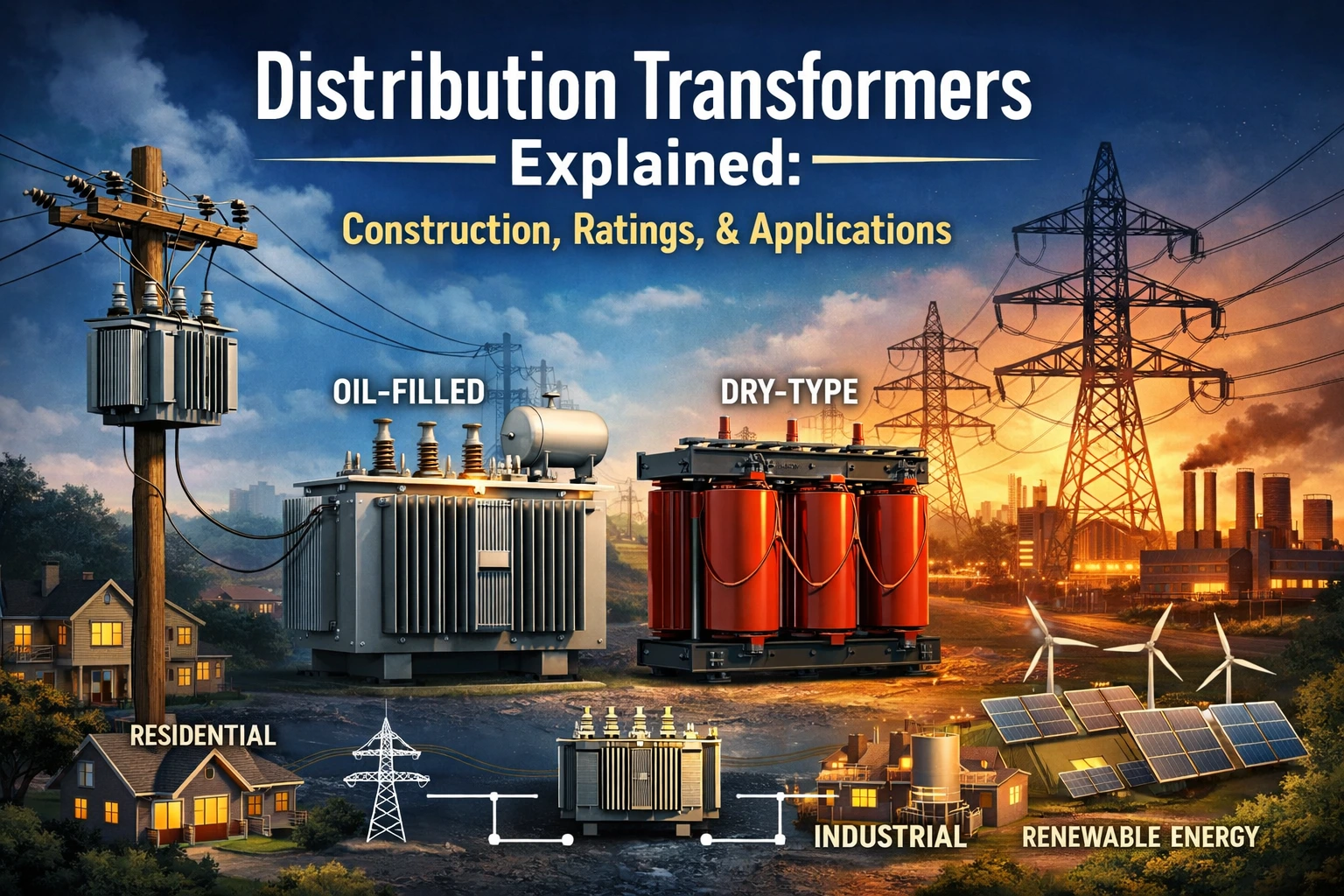
Distribution Transformers Explained: Construction, Ratings, and Applications
Every time you flip a switch, charge your phone, or power a machine, you rely on a piece of equipment you rarely see. It does not make noise. It does not demand attention. Yet without it, modern life would stop instantly.
That quiet guardian of everyday electricity is the distribution transformer.
You may work in electrical engineering, construction, utilities, or industrial maintenance—or you may simply want to understand how electricity reaches your home safely. Either way, learning how distribution transformers work gives you clarity, confidence, and better decision-making power. This guide walks you through their construction, ratings, applications, and real-world selection considerations, step by step, without unnecessary complexity.
Table of Contents
What Are Distribution Transformers?
Definition of Distribution Transformers
A distribution transformer is an electrical device designed to reduce medium-voltage electricity to a lower voltage suitable for end users. You encounter it at the final stage of the power delivery chain, just before electricity enters homes, offices, factories, or commercial buildings.
In practical terms, distribution transformers typically step voltage down from levels such as:
- 33 kV
- 22 kV
- 11 kV
to commonly used secondary voltages like:
- 415/240 V
- 400/230 V
- 208/120 V
This voltage reduction ensures electricity can be used safely and efficiently without damaging equipment or creating hazards.
Role of Distribution Transformers in the Power System
You can think of the electrical grid as a layered system:
- Generation – power plants produce electricity
- Transmission – high voltage moves power over long distances
- Distribution – electricity is prepared for end users
Distribution transformers sit at the most critical junction. They ensure:
- Voltage stability
- Load balancing
- Electrical isolation
- Reduced energy losses at consumption level
Without them, the grid would be unusable for daily applications.
Construction of Distribution Transformers
Understanding construction helps you evaluate performance, lifespan, and reliability.
Core Components of Distribution Transformers
Magnetic Core
The core provides a low-reluctance path for magnetic flux. You will typically find:
- Laminated silicon steel sheets
- High permeability materials
- Reduced hysteresis losses
Core designs include:
- Core-type
- Shell-type
Each design influences efficiency and mechanical strength.
Windings
Windings transfer electrical energy between voltage levels.
You usually see:
- Primary winding (medium voltage side)
- Secondary winding (low voltage side)
Materials used:
- Copper (higher conductivity, higher cost)
- Aluminum (lighter, cost-effective)
Insulation System
Insulation prevents short circuits and thermal failure. Common systems include:
- Cellulose paper insulation
- Mineral oil insulation
- Epoxy resin (for dry types)
Proper insulation directly affects transformer lifespan.
Main Components and Their Functions
| Component | Function |
|---|---|
| Core | Transfers magnetic flux |
| Primary winding | Receives incoming voltage |
| Secondary winding | Delivers usable voltage |
| Insulation | Prevents electrical faults |
| Tank | Protects internal components |
| Cooling system | Controls operating temperature |
Cooling Methods Used in Distribution Transformers
Heat management is essential because excess temperature shortens transformer life.
Oil-Immersed Distribution Transformers
These units use insulating oil for:
- Cooling
- Electrical insulation
- Arc suppression
Common cooling classifications:
- ONAN (Oil Natural Air Natural)
- ONAF (Oil Natural Air Forced)
Dry-Type Distribution Transformers
Dry-type transformers rely on air or resin insulation. They are often installed indoors where fire safety is critical.
Typical environments include:
- Hospitals
- Commercial buildings
- Underground substations
Oil vs Dry-Type Distribution Transformers
| Feature | Oil-Filled | Dry-Type |
|---|---|---|
| Cooling efficiency | High | Moderate |
| Fire risk | Higher | Lower |
| Maintenance | Periodic oil testing | Minimal |
| Cost | Lower upfront | Higher upfront |
| Indoor use | Limited | Ideal |
Distribution Transformer Ratings Explained
Transformer ratings define how much load you can safely place on the unit.
kVA Rating of Distribution Transformers
Distribution transformers are rated in kVA, not kW, because losses depend on current and voltage rather than load power factor.
Common ratings include:
- 25 kVA
- 50 kVA
- 100 kVA
- 250 kVA
- 500 kVA
- 1000 kVA
You must size the transformer based on:
- Maximum demand
- Load diversity
- Future expansion
Voltage Ratings
Primary and secondary voltages vary by region.
| Region | Common Primary Voltage | Secondary Voltage |
|---|---|---|
| US | 13.8 kV | 120/240 V |
| EU | 11 kV | 400/230 V |
| IEC regions | 22 kV | 415/240 V |
Efficiency and Losses
Losses fall into two categories:
- Core losses (constant)
- Copper losses (load-dependent)
Modern distribution transformers are designed to meet:
- DOE efficiency standards
- IEC 60076 limits
- EcoDesign regulations
Higher efficiency means:
- Lower operating costs
- Reduced heat
- Longer service life
Types of Distribution Transformers
Pole-Mounted Distribution Transformers
You typically see these in overhead networks.
Advantages:
- Low installation cost
- Easy access
- Suitable for rural areas
Pad-Mounted Distribution Transformers
Installed at ground level in locked enclosures.
Common uses:
- Urban zones
- Underground networks
- Commercial developments
Single-Phase vs Three-Phase Distribution Transformers
| Type | Application |
|---|---|
| Single-phase | Homes, small shops |
| Three-phase | Industry, large buildings |
Three-phase transformers provide better load balance and efficiency for high-demand systems.
Applications of Distribution Transformers
Residential Applications
You rely on distribution transformers to power:
- Lighting
- Appliances
- HVAC systems
- Charging stations
They ensure voltage remains stable even during peak demand.
Commercial Applications
Used in:
- Offices
- Retail centers
- Hotels
- Data centers
Reliability is essential to avoid downtime and equipment damage.
Industrial Applications
Factories depend on distribution transformers for:
- Motors
- Production lines
- Automation systems
- Heavy machinery
Incorrect transformer selection can cause costly shutdowns.
Renewable Energy Integration
Distribution transformers now support:
- Solar PV systems
- Wind farms
- Battery storage
- Smart grids
They play a growing role in decentralized energy networks.
Standards and Regulations for Distribution Transformers
International Standards
You should always verify compliance with:
- IEC 60076
- IEEE C57
- ANSI standards
These standards ensure safety, efficiency, and interoperability.
Energy Efficiency Regulations
Governments increasingly regulate transformer losses to reduce energy waste.
Key frameworks include:
- DOE (United States)
- EcoDesign (European Union)
How to Select the Right Distribution Transformer
Key Selection Criteria
When choosing a distribution transformer, evaluate:
- Load profile
- Voltage compatibility
- Installation environment
- Cooling requirements
- Efficiency class
Common Mistakes to Avoid
- Undersizing the transformer
- Ignoring harmonic loads
- Poor ventilation planning
- Overlooking future expansion
Avoiding these errors saves money and prevents failures.
Maintenance and Lifespan of Distribution Transformers
Routine Maintenance Practices
Proper maintenance includes:
- Oil dielectric testing
- Thermal inspections
- Load monitoring
- Bushing checks
Expected Service Life
A well-maintained distribution transformer typically lasts:
- 20 to 30 years
- Longer with modern monitoring systems
Environmental conditions and loading patterns strongly influence longevity.
Advantages of Modern Distribution Transformers
Modern designs offer:
- Higher efficiency
- Lower losses
- Digital monitoring
- Improved safety
- Better environmental performance
These benefits translate into long-term operational savings.
Frequently Asked Questions About Distribution Transformers
What is the purpose of distribution transformers?
Distribution transformers reduce medium voltage electricity to safe, usable levels for consumers and equipment.
How long do distribution transformers last?
Most distribution transformers operate reliably for 20–30 years with proper maintenance.
What is the difference between power transformers and distribution transformers?
Power transformers handle bulk transmission, while distribution transformers serve end users.
Which distribution transformer is best for residential use?
Single-phase, oil-filled or dry-type units rated between 25–100 kVA are commonly used.
How are distribution transformers rated?
They are rated in kVA based on voltage, current, and thermal limits.
Conclusion
Distribution transformers may not be visible in your daily routine, but they are fundamental to safe and reliable electricity delivery. When you understand their construction, ratings, and applications, you make better technical and financial decisions—whether you are designing a network, managing infrastructure, or selecting equipment.
As energy demand grows and grids evolve, distribution transformers will continue to shape how electricity reaches you efficiently and safely.