
Electrical Wiring Standards You Must Know
Introduction: Why Electrical Wiring Standards Are Not Optional
Every electrical system you install carries more than current. It carries responsibility. One incorrectly sized conductor, one missing earth connection, or one misunderstood regulation can silently turn a building into a hazard. Many electrical fires, equipment failures, and shock incidents do not come from dramatic overloads or lightning strikes. They begin with ordinary wiring work done without full respect for electrical wiring standards.
You may have seen it yourself: cables that feel warm when they should not, breakers that trip for no clear reason, or installations that “work” but never feel right. Electrical wiring standards exist because real systems failed, people were injured, and lessons were learned the hard way. When you follow these standards, you are not just satisfying inspectors—you are applying decades of engineering experience to protect lives, property, and your professional credibility.
This guide walks you through electrical wiring standards you must know, explains why they matter, and shows you how to apply them correctly in real installations.
Table of Contents
What Are Electrical Wiring Standards?
Definition of Electrical Wiring Standards
Electrical wiring standards are technical rules and requirements that define how electrical systems must be designed, installed, protected, tested, and maintained. These rules specify:
- Conductor sizes and materials
- Insulation types and voltage ratings
- Protection methods against overload, short circuit, and electric shock
- Earthing and bonding arrangements
- Installation practices for different environments
When you follow electrical wiring standards, you ensure that current flows where it should, faults clear safely, and equipment operates within its design limits.
Who Creates Electrical Wiring Standards?
Electrical wiring standards are developed by international and national bodies composed of engineers, researchers, manufacturers, inspectors, and safety authorities. The most influential include:
- IEC (International Electrotechnical Commission) – widely used in Europe, Africa, Asia, and many other regions
- NEC / NFPA (National Electrical Code) – used in the United States
- BS 7671 (UK Wiring Regulations)
- VDE (Germany)
Your local regulations are usually based on one of these systems, sometimes with national modifications. Understanding the foundation helps you work confidently across regions and projects.
Why Electrical Wiring Standards Are Critical for Safety and Compliance
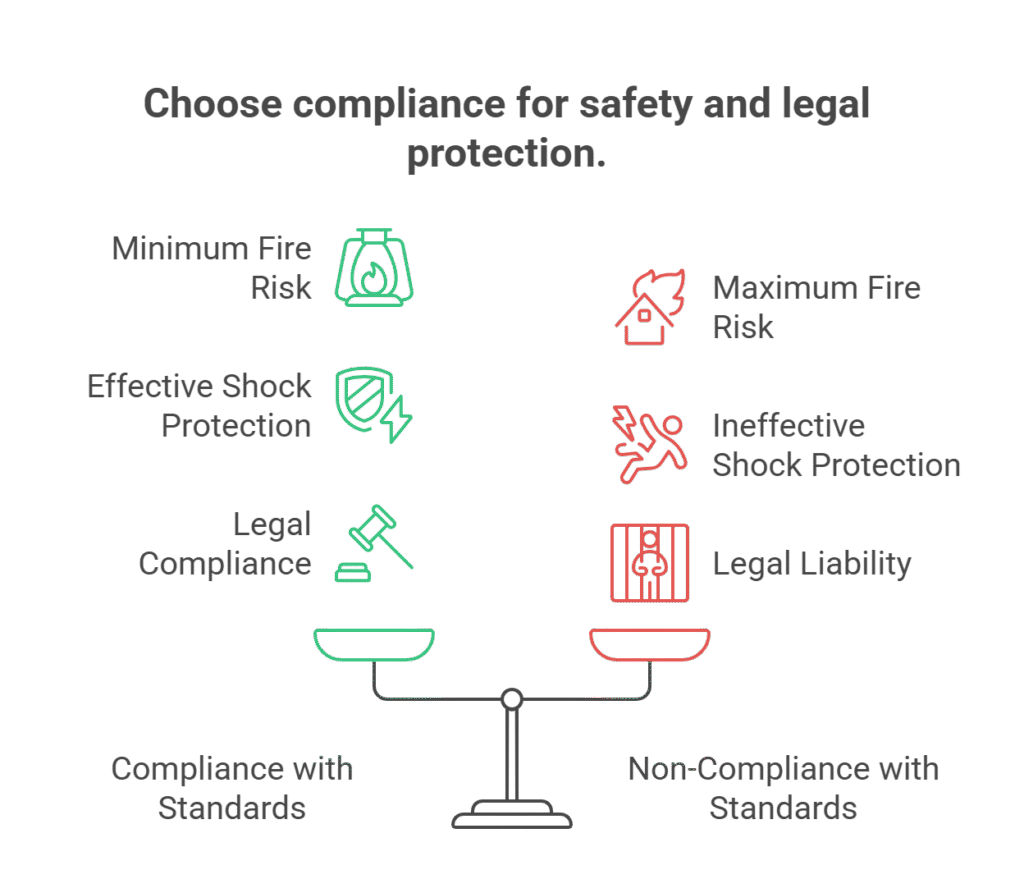
Fire Prevention
Electrical fires are most often caused by heat. Heat comes from resistance, and resistance increases when conductors are undersized, connections are loose, or insulation degrades.
Electrical wiring standards control fire risk by defining:
- Minimum conductor cross-sectional areas
- Maximum permissible temperatures
- Installation methods that allow heat dissipation
- Correct coordination between cables and protective devices
When you ignore these requirements, overheating becomes invisible and progressive until ignition occurs.
Shock and Electrocution Protection
Electric shock happens when fault current passes through the human body instead of a safe path. Standards prevent this by requiring:
- Effective earthing systems
- Proper bonding of exposed conductive parts
- Automatic disconnection of supply using breakers or RCDs
Without these measures, protection devices may never operate, even during dangerous faults.
Legal and Insurance Consequences
If your installation does not comply with electrical wiring standards:
- Inspections can fail
- Occupancy permits can be denied
- Insurance claims may be rejected
- Liability shifts directly to you
Compliance is not optional; it is a legal and professional obligation.
Major Electrical Wiring Standards You Must Know Worldwide
IEC Electrical Wiring Standards
IEC standards form the backbone of electrical installations in most of the world. They focus on performance-based safety principles rather than prescriptive rules alone.
Key characteristics:
- Metric system (mm² conductors)
- Emphasis on earthing systems (TT, TN, IT)
- Detailed correction factors for temperature, grouping, and installation method
- Strong focus on testing and verification
If you work in Europe, Africa, the Middle East, or parts of Asia, IEC-based wiring standards define your daily work.
NEC (National Electrical Code – USA)
The NEC uses a different structure and terminology, but the safety goals are the same.
Distinctive features:
- AWG conductor sizing
- Highly prescriptive rules
- Frequent updates (every three years)
- Strong focus on residential and commercial occupancies
Understanding NEC principles is essential if you work with U.S.-based projects or equipment.
Regional and National Adaptations
Most countries adapt international standards to local conditions such as climate, building practices, and voltage systems. You must always verify which edition and amendments apply in your jurisdiction.
Core Electrical Wiring Rules Every Electrician Must Follow
Cable Sizing and Current-Carrying Capacity
Cable sizing is not a guess. It is a calculation.
Electrical wiring standards require you to consider:
- Design current of the circuit
- Installation method (conduit, tray, buried, free air)
- Ambient temperature
- Grouping of cables
- Permissible voltage drop
A cable that carries current safely in open air may overheat inside conduit. Standards provide correction factors to adjust for these conditions.
Example: IEC Cable Sizing Table (Simplified)
| Cable Size (mm²) | Typical Current Rating (A) | Common Application |
|---|---|---|
| 1.5 | 14–18 | Lighting circuits |
| 2.5 | 20–25 | Socket outlets |
| 6 | 32–40 | Small sub-circuits |
| 10 | 50–63 | Feeders |
You must always apply correction factors before final selection.
Electrical Wiring Color Codes
Color codes exist to prevent dangerous confusion.
IEC Color Codes
| Conductor | Color |
|---|---|
| Phase (L) | Brown |
| Neutral (N) | Blue |
| Earth (PE) | Green/Yellow |
NEC Color Codes (Common Practice)
| Conductor | Color |
|---|---|
| Hot | Black / Red |
| Neutral | White |
| Ground | Green / Bare |
Mixing color codes without clear identification violates electrical wiring standards and creates serious maintenance risks.
Earthing and Bonding Requirements
Earthing is the foundation of electrical safety.
Electrical wiring standards require you to:
- Provide a low-impedance path for fault current
- Bond all exposed conductive parts
- Ensure protective devices operate within required disconnection times
Common Earthing Systems (IEC)
- TT – local earth electrode, RCD-dependent protection
- TN – earth provided by supply, strong fault currents
- IT – isolated or impedance-earthed systems for continuity
Each system has specific wiring and protection rules that must be respected.
Electrical Wiring Standards for Different Applications
Residential Electrical Wiring Standards
In residential installations, standards focus on user safety and simplicity.
Key requirements include:
- RCD protection for socket outlets
- Special rules for bathrooms and kitchens
- Adequate circuit separation
- Limiting voltage drop to protect appliances
Even small homes require systematic design, not improvisation.
Commercial and Industrial Installations
Commercial and industrial systems introduce higher fault levels, continuous loads, and operational constraints.
Standards address:
- Cable derating for continuous operation
- Selective coordination of protection devices
- Mechanical protection and containment
- Emergency power and redundancy
Ignoring these rules results in nuisance tripping, downtime, and equipment damage.
Special Environments
Electrical wiring standards become stricter in hazardous conditions:
- Wet locations require higher IP ratings
- Outdoor installations need UV-resistant insulation
- Explosive atmospheres demand certified equipment
You must treat environment classification as a design parameter, not an afterthought.
Common Wiring Mistakes That Violate Electrical Wiring Standards
Undersized Conductors
This is the most common and dangerous mistake. It leads to:
- Chronic overheating
- Insulation breakdown
- Fire risk
A breaker does not protect a cable from slow thermal damage if the cable is incorrectly selected.
Incorrect Protection Devices
Protection must match the cable and load.
Typical violations include:
- Oversized breakers
- Missing RCDs
- Incorrect tripping curves
Standards require coordination, not random selection.
Poor Terminations and Connections
Loose connections increase resistance and heat.
Electrical wiring standards specify:
- Correct torque values
- Approved terminals
- Maximum number of conductors per terminal
Most electrical failures begin at terminations.
How to Ensure Your Electrical Installation Meets Wiring Standards
Planning Before Installation
Before pulling any cable, you must:
- Calculate loads
- Select earthing system
- Define protection strategy
- Verify voltage drop limits
Standards assume planning, not improvisation.
Using Approved Materials
Certified materials matter.
You must ensure:
- Correct voltage rating
- Fire resistance where required
- Manufacturer compliance documentation
Unapproved components invalidate the entire installation.
Testing and Inspection
No installation is complete without testing.
Electrical wiring standards require:
- Continuity testing
- Insulation resistance measurement
- Earth loop impedance verification
- Functional testing of protection devices
Testing transforms design into verified safety.
Electrical Wiring Standards Reference Tables
Voltage Drop Limits (Typical IEC Values)
| Circuit Type | Maximum Voltage Drop |
|---|---|
| Lighting | 3% |
| Power | 5% |
Installation Compliance Checklist
| Item | Requirement | Status |
|---|---|---|
| Cable size verified | Standard-compliant | ✔ |
| Earthing continuity | Verified | ✔ |
| RCD operation | Tested | ✔ |
Tables like these reduce errors and improve consistency.
Frequently Asked Questions About Electrical Wiring Standards
What electrical wiring standards should you follow?
You must follow the standard adopted by your country and enforced by local authorities. Always verify the current edition.
Are electrical wiring standards mandatory?
Yes. They are legal requirements, not recommendations.
How often do electrical wiring standards change?
Most standards update every three to five years to reflect new technology and safety research.
Can you mix IEC and NEC electrical wiring standards?
Mixing standards is unsafe and non-compliant unless explicitly permitted by local regulation.
What happens if electrical wiring standards are not followed?
Consequences include fire risk, inspection failure, legal liability, and loss of professional credibility.
Conclusion: Electrical Wiring Standards Are the Backbone of Safe Power Systems
Electrical wiring standards are not obstacles to creativity or speed. They are the distilled experience of generations of engineers who solved the same problems you face today. When you apply these standards correctly, you deliver systems that are safe, efficient, durable, and trusted.
Your work does not end when the lights turn on. It ends when the installation remains safe years later under real conditions.
Call to Action
If you want to elevate your electrical work:
- Treat standards as daily tools
- Use calculation tables consistently
- Test every installation
- Stay updated with new editions
Safe systems begin with informed decisions—and those decisions start with mastering electrical wiring standards.