
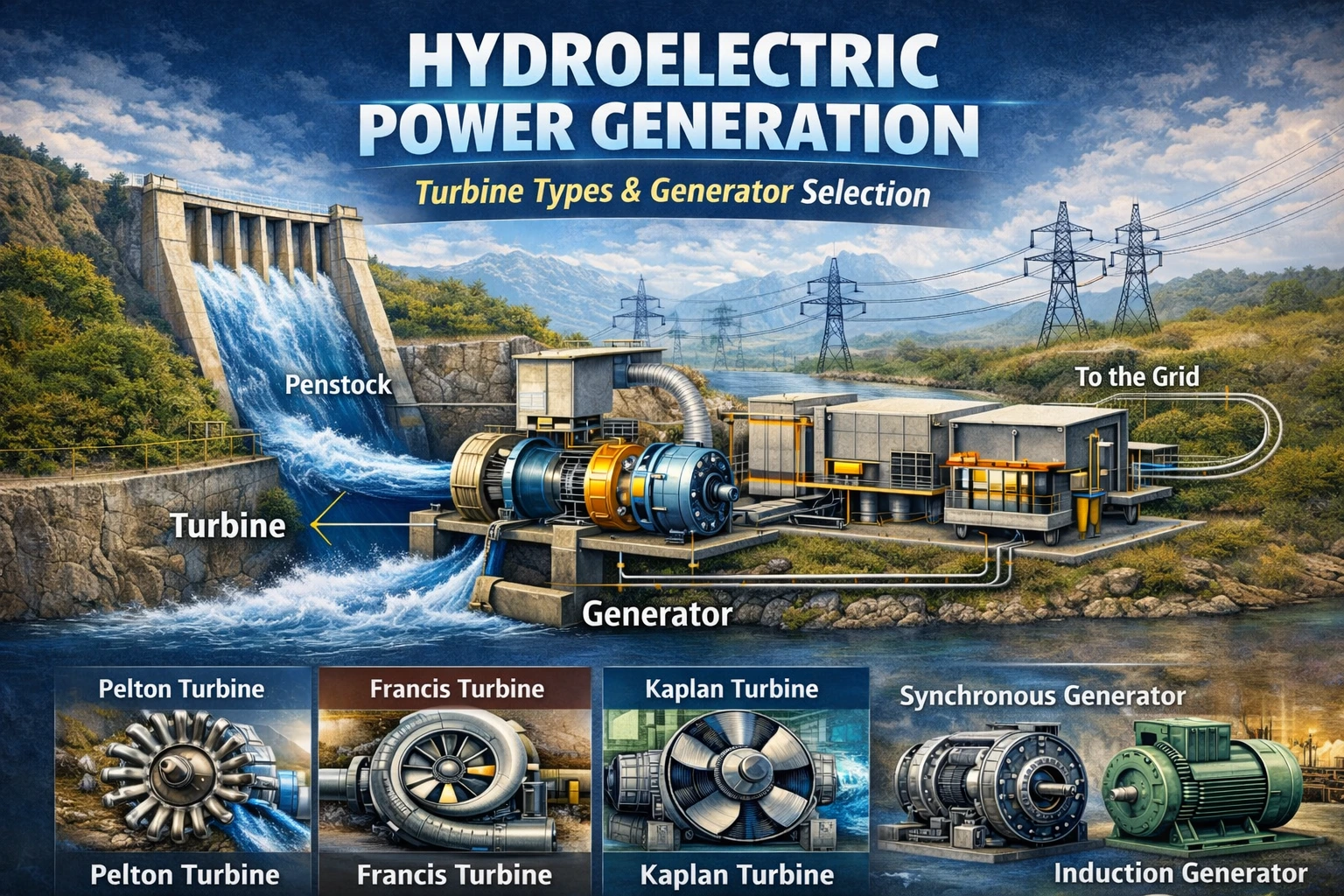
Hydroelectric Power Generation: Turbine Types and Generator Selection
Water has been shaping human civilization long before electricity existed. Rivers powered mills, supported agriculture, and defined cities. Today, that same moving water quietly produces electricity for millions of homes. When you flip a switch and the lights come on without smoke, fuel, or noise, there is a strong chance hydroelectric power generation is working somewhere upstream.
If you are involved in electrical engineering, energy planning, or technical education, understanding how hydroelectric power generation works—and how turbines and generators are selected—is not optional. It is foundational knowledge that connects physics, mechanics, and power systems into one reliable source of renewable energy.
This guide walks you step by step through hydroelectric power generation, with a strong focus on turbine types and generator selection, using clear explanations rather than abstract theory. By the end, you will understand not only how hydro plants work, but why engineers choose specific equipment for each site.
Table of Contents
What Is Hydroelectric Power Generation?
Hydroelectric power generation is the process of converting the energy of moving or falling water into electrical energy. Unlike fossil fuel plants, no combustion occurs. Instead, gravity and water flow perform the work.
At its core, hydroelectric power generation follows a simple energy conversion chain:
- Potential energy stored in water at height
- Kinetic energy as water flows downward
- Mechanical energy as a turbine rotates
- Electrical energy produced by a generator
What makes hydroelectric systems unique is their stability. Once built, they can operate continuously for decades with relatively low operating costs.
Basic Working Principle of Hydroelectric Power Generation
When water flows from a higher elevation to a lower one, it gains velocity. Engineers capture this energy by directing the water through a controlled path toward a turbine.
The process works as follows:
- Water is stored in a reservoir or diverted from a river
- The water flows through a penstock toward the turbine
- The turbine converts water energy into rotational motion
- A generator converts that rotation into electricity
- A transformer steps up the voltage for transmission
This process happens continuously, as long as water flow is available.
Main Components of a Hydroelectric Power Plant
Each component in a hydroelectric power generation system has a precise role. If one part is poorly designed or mismatched, efficiency and reliability suffer.
| Component | Function | Why It Matters |
|---|---|---|
| Dam / Intake | Controls water flow | Determines head and stability |
| Penstock | Channels water | Affects pressure losses |
| Turbine | Converts water energy | Core efficiency driver |
| Generator | Produces electricity | Controls voltage & frequency |
| Transformer | Steps up voltage | Reduces transmission losses |
| Switchyard | Grid connection | Power system protection |
Understanding these elements helps you see why turbine and generator selection cannot be treated independently.
Key Factors Affecting Hydroelectric Power Generation
Not every river or dam produces the same amount of power. The performance of hydroelectric power generation depends on a few critical physical parameters.
Hydraulic Head
Hydraulic head refers to the vertical distance between the water source and the turbine. It is the most influential factor in turbine selection.
- High head means high pressure but lower flow
- Low head means large flow but lower pressure
Even a small change in head can significantly affect power output.
Water Flow Rate
Flow rate describes how much water passes through the turbine per second. Seasonal variations in rainfall can change flow dramatically.
Engineers must design systems that:
- Operate efficiently at average flow
- Survive extreme flow conditions
- Remain stable during low-water periods
Power Output Equation
The theoretical power available from hydroelectric power generation is calculated using:
P = ρ × g × Q × H × η
Where:
- ρ = water density
- g = gravity
- Q = flow rate
- H = net head
- η = system efficiency
This equation directly links natural site conditions to equipment sizing.
Types of Turbines Used in Hydroelectric Power Generation
The turbine is the heart of any hydroelectric system. Selecting the wrong turbine leads to low efficiency, vibration, and mechanical failure.
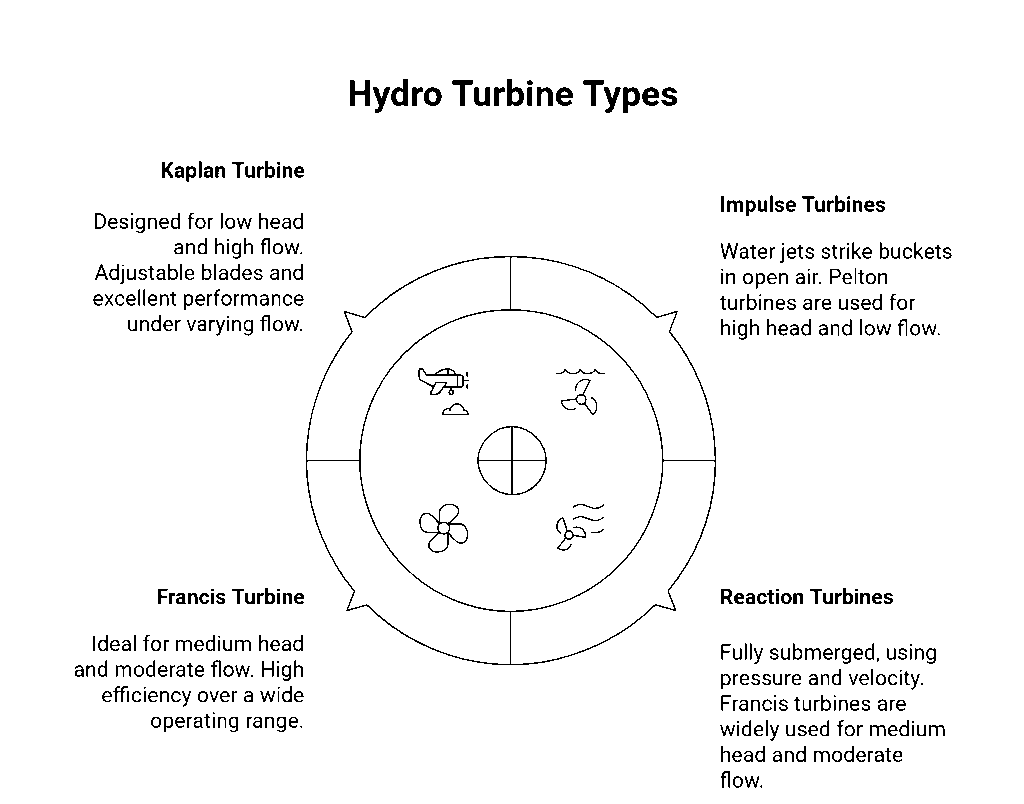
Hydro turbines fall into two main categories: impulse turbines and reaction turbines.
Impulse Turbines
Impulse turbines operate using high-speed water jets striking turbine buckets in open air.
Pelton Turbine
Pelton turbines are used when:
- Hydraulic head is very high
- Water flow is relatively low
Key characteristics:
- Water jet hits spoon-shaped buckets
- Operates efficiently at constant speed
- Common in mountainous regions
Pelton turbines are mechanically robust and highly efficient for specific site conditions.
Reaction Turbines
Reaction turbines operate fully submerged, using both pressure and velocity.
Francis Turbine
Francis turbines are the most widely used turbines in hydroelectric power generation.
They are ideal when:
- Head is medium
- Flow rate is moderate
Advantages:
- High efficiency over a wide operating range
- Compact design
- Suitable for grid-connected plants
Kaplan Turbine
Kaplan turbines are designed for:
- Low head
- High flow
Distinct features:
- Adjustable blades
- Excellent performance under varying flow
- Common in river-based plants
Kaplan turbines are often chosen where water levels fluctuate frequently.
Turbine Comparison Table
| Turbine Type | Head Range | Flow Rate | Typical Use |
|---|---|---|---|
| Pelton | High | Low | Mountain hydro |
| Francis | Medium | Medium | General-purpose |
| Kaplan | Low | High | River plants |
This comparison shows why turbine selection must always start with site analysis.
Turbine Selection Criteria in Hydroelectric Power Generation
Choosing a turbine is not a guess. Engineers evaluate several technical parameters before making a decision.
Selection Based on Head and Flow
The relationship between head and flow defines turbine suitability. Using a turbine outside its optimal range leads to:
- Reduced efficiency
- Cavitation damage
- Shortened equipment life
Speed and Efficiency Considerations
Each turbine has a specific speed range. That speed must align with the generator’s requirements to avoid complex mechanical solutions.
Higher efficiency means:
- More power from the same water
- Lower operating costs
- Better long-term reliability
Environmental and Site Constraints
Modern hydroelectric power generation must also consider:
- Sediment erosion
- Fish migration
- Noise and vibration
- Flood management
Equipment selection increasingly balances performance with environmental responsibility.
Generator Types Used in Hydroelectric Power Generation
Once mechanical energy is produced, it must be converted into electrical energy. That is the generator’s role.
Synchronous Generators
Synchronous generators dominate hydroelectric power generation because they provide:
- Stable voltage control
- Accurate frequency regulation
- Direct grid synchronization
They operate at a fixed speed determined by grid frequency and pole count.
Induction Generators (Limited Applications)
Induction generators are sometimes used in small hydro plants.
They:
- Require grid excitation
- Offer simpler construction
- Are less suitable for large plants
For utility-scale hydroelectric power generation, synchronous generators remain the standard.
Generator Selection Criteria for Hydroelectric Power Plants
Selecting a generator is not only about power rating. Several electrical and mechanical factors matter.
Power Rating and Voltage Level
The generator must:
- Match turbine output
- Handle overloads safely
- Operate continuously without overheating
Voltage selection affects transformer size and insulation requirements.
Speed Matching With Turbine
Generators must match turbine rotational speed. This is achieved by:
- Selecting appropriate pole numbers
- Avoiding unnecessary gearboxes
Direct coupling improves efficiency and reliability.
Cooling and Insulation Class
Hydroelectric generators often operate continuously for years.
Design considerations include:
- Air or water cooling
- High insulation classes
- Resistance to humidity
| Parameter | Requirement |
|---|---|
| Rated Power | Matches turbine |
| Speed | Fixed by grid |
| Cooling | Continuous duty |
| Insulation | Long service life |
Grid Connection and Power Quality in Hydroelectric Power Generation
Hydro plants must synchronize precisely with the grid before connecting.
Synchronization Requirements
Before connection:
- Voltage must match
- Frequency must match
- Phase angle must align
Failure in synchronization can damage equipment instantly.
Role of the Excitation System
Excitation systems control:
- Generator voltage
- Reactive power
- System stability
Modern digital exciters improve response speed and grid support.
Efficiency, Losses, and Optimization
No system is loss-free. Hydroelectric power generation losses occur at several stages.
Turbine Losses
- Hydraulic friction
- Leakage
- Mechanical resistance
Generator Losses
- Copper losses
- Core losses
- Ventilation losses
Improving Overall Efficiency
Efficiency improves through:
- Correct equipment sizing
- Regular maintenance
- Modern monitoring systems
- Accurate control strategies
Advantages and Limitations of Hydroelectric Power Generation
Advantages
- Renewable and clean
- High reliability
- Long service life
- Low operating cost
Limitations
- High initial investment
- Environmental impact
- Site-specific feasibility
Understanding both sides helps you design realistic energy solutions.
Future Trends in Hydroelectric Power Generation
Hydroelectric power generation continues to evolve.
Key trends include:
- Small and micro-hydro systems
- Digital monitoring and automation
- Hybrid hydro-solar plants
- Advanced turbine materials
These innovations extend the relevance of hydro power in modern grids.
Frequently Asked Questions About Hydroelectric Power Generation
What is hydroelectric power generation and how does it work?
It converts water energy into electricity using turbines and generators driven by flowing water.
Which turbine is best for hydroelectric power generation?
The best turbine depends on head and flow, not preference.
Why are synchronous generators used in hydroelectric power plants?
They provide stable frequency, voltage control, and grid compatibility.
How is generator size selected in hydroelectric power generation?
It is based on turbine output, operating conditions, and safety margins.
Is hydroelectric power generation suitable for small-scale projects?
Yes, micro-hydro systems can power isolated communities effectively.
Conclusion
Hydroelectric power generation is not just about water and turbines. It is about precise engineering decisions that balance natural conditions, mechanical design, and electrical performance. When turbine types are matched correctly to site conditions and generators are selected with care, hydro plants deliver reliable power for generations.
If you want to deepen your expertise, explore related articles on power transmission, step-up transformers, and grid synchronization on zoneleec.com. Share this guide with colleagues, ask questions, and apply these principles in real-world projects—because clean, reliable energy starts with informed decisions.