
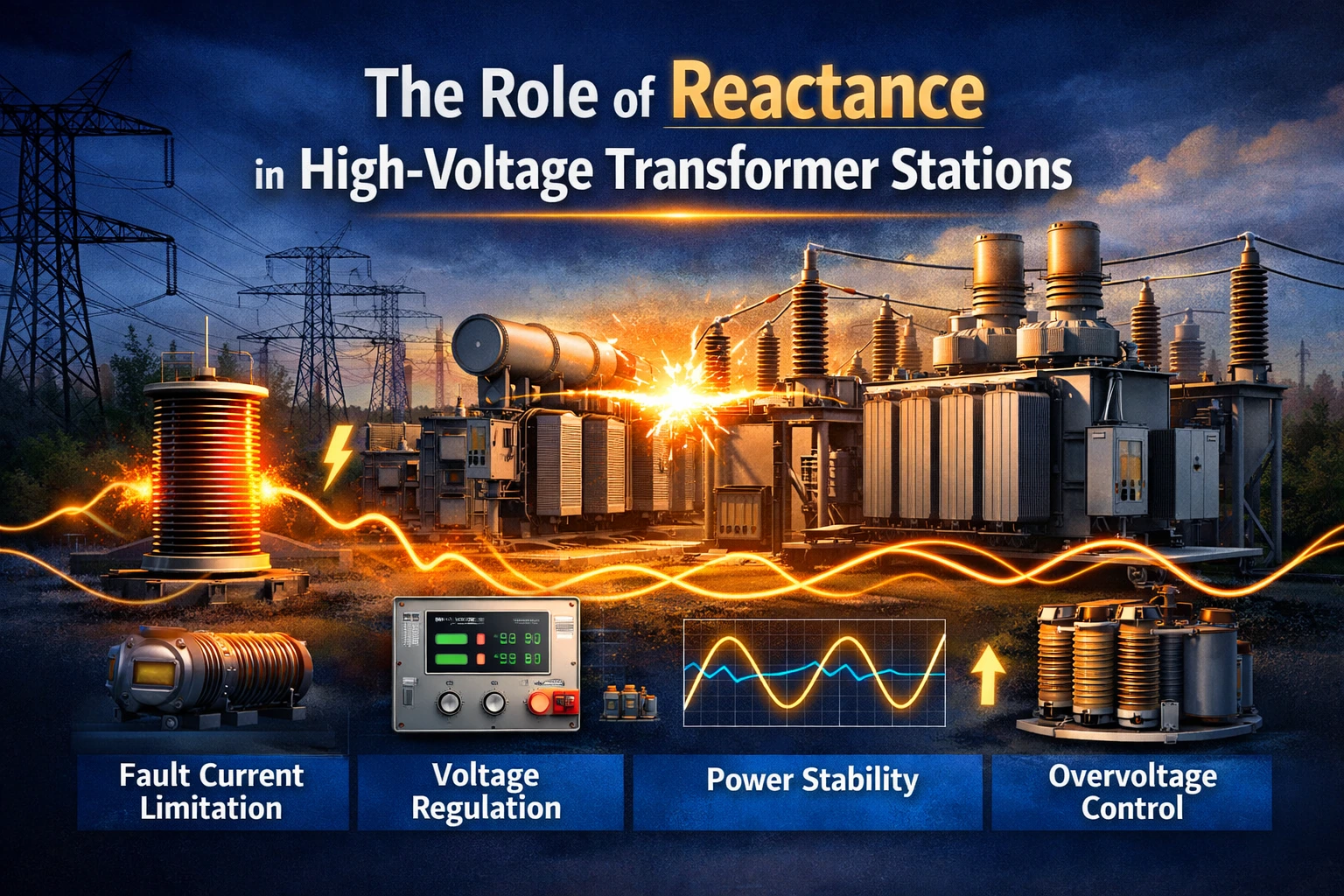
What Is the Role of Reactance in High-Voltage Transformer Stations?
When you think about electricity, you probably picture voltage, current, and power flowing instantly when you flip a switch. What you rarely see is the hidden electrical behavior that keeps that power stable, controlled, and safe—especially at high voltages. One of the most critical yet misunderstood elements behind this stability is reactance.
In high-voltage transformer stations, reactance is not a theoretical concept buried in textbooks. It is a practical, engineered safeguard that shapes how your power system behaves during normal operation, heavy loading, and even severe faults. If reactance is poorly understood or incorrectly applied, the result can be voltage instability, equipment damage, or widespread outages.
By the end of this article, you will clearly understand what reactance is, why it matters in high-voltage transformer stations, and how voltage regulators rely on reactance to maintain power stability—all from a practical, real-world perspective.
Table of Contents
Why Reactance Is the Silent Guardian of Power System Stability
Every modern power grid operates under constant stress. Loads change by the second, renewable sources fluctuate unpredictably, and faults can occur without warning. Yet, despite these challenges, you expect the voltage delivered to homes, factories, and hospitals to remain within tight limits.
Reactance is one of the key reasons this expectation is met.
Unlike resistance, which dissipates energy as heat, reactance temporarily stores energy in magnetic or electric fields and then releases it back into the system. This behavior allows reactance to:
- Limit excessive fault currents
- Control voltage rise and drop
- Support voltage regulation devices
- Stabilize power flow during disturbances
In high-voltage transformer stations, reactance acts as a buffer between unpredictable electrical events and sensitive equipment. Without it, voltage regulators would struggle to maintain control, and protection systems would face extreme stress.
Understanding Reactance in Electrical Power Systems
What Is Reactance?
Reactance is the opposition that inductors and capacitors present to alternating current (AC). Unlike resistance, reactance does not consume energy. Instead, it stores energy temporarily and returns it to the system.
You will encounter two main forms:
- Inductive reactance (XL) – produced by coils, windings, and magnetic fields
- Capacitive reactance (XC) – produced by capacitors and electric fields
Because high-voltage systems rely heavily on transformers, reactors, and long transmission lines, inductive reactance dominates most substations.
From a practical standpoint, reactance determines how quickly current can change. This single characteristic makes it invaluable for controlling faults, voltage variations, and dynamic system behavior.
Reactance vs Resistance: Why the Difference Matters
Understanding the difference between resistance and reactance is essential if you want to grasp voltage regulation.
| Property | Resistance | Reactance |
|---|---|---|
| Energy behavior | Dissipates energy | Stores and returns energy |
| Frequency dependent | No | Yes |
| Effect on power | Reduces active power | Affects reactive power |
| Role in stability | Limited | Critical |
Resistance mainly affects losses. Reactance affects control. In high-voltage transformer stations, control is everything.
Types of Reactance Used in High-Voltage Systems
Reactance appears in multiple forms throughout a transformer station. Each type serves a specific purpose.
Leakage Reactance in Transformers
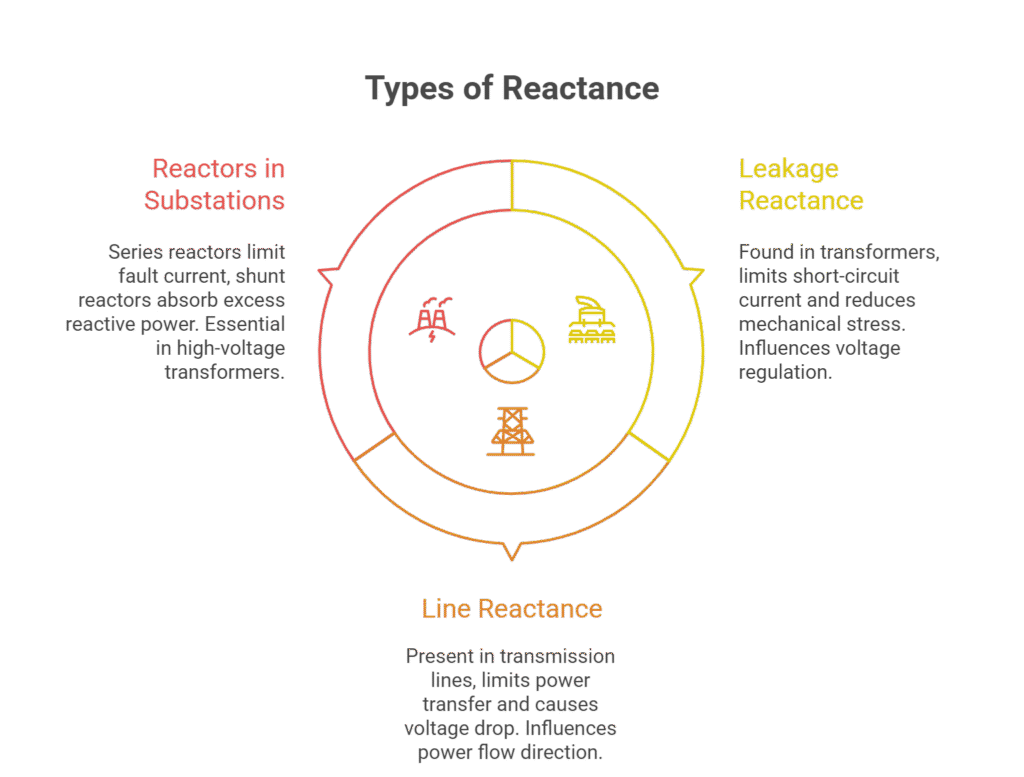
Every power transformer has leakage reactance due to imperfect magnetic coupling between windings. You may not see it physically, but it is carefully designed into the transformer.
Its functions include:
- Limiting short-circuit current
- Reducing mechanical stress during faults
- Influencing voltage regulation
Transformer leakage reactance is often expressed as a percentage and plays a major role in system fault calculations.
Line Reactance in Transmission Networks
High-voltage transmission lines behave like distributed inductors. Their reactance:
- Limits power transfer capability
- Causes voltage drop under load
- Influences power flow direction
Voltage regulators and reactive compensation devices are designed with this line reactance in mind.
Reactors Used in Substations
Dedicated reactors are installed to introduce controlled reactance where needed:
- Series reactors to limit fault current
- Shunt reactors to absorb excess reactive power
These components are essential in modern high-voltage transformer stations.
The Role of Reactance in High-Voltage Transformer Stations
How Reactance Controls Fault Currents
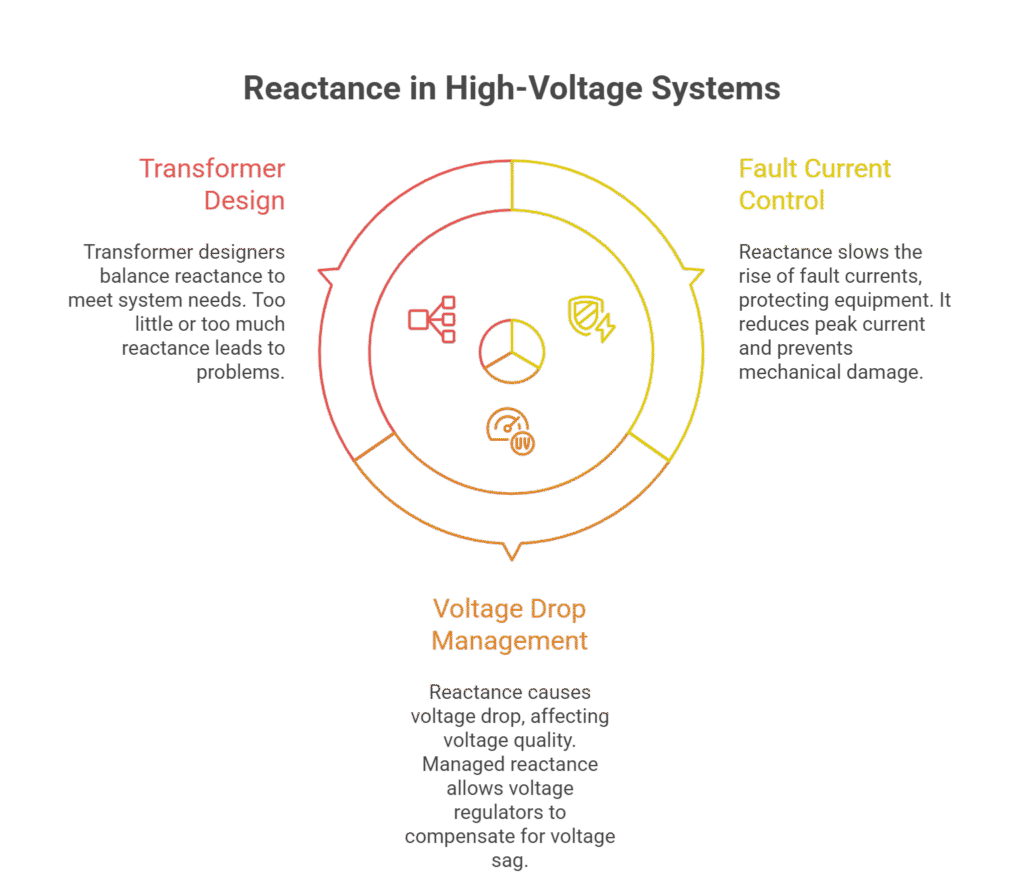
When a short circuit occurs, current can rise to destructive levels within milliseconds. Reactance slows this rise.
By opposing sudden changes in current, reactance:
- Reduces peak fault current
- Protects circuit breakers from exceeding interrupting capacity
- Prevents catastrophic mechanical damage to transformer windings
Without sufficient reactance, even the best protection systems may fail due to excessive stress.
Reactance and Voltage Drop Management
Every ampere flowing through reactance produces a voltage drop. In high-voltage transformer stations, this relationship directly affects voltage quality.
You see the effects when:
- Heavy loads cause voltage sag
- Long transmission distances amplify voltage drop
- Reactive power demand increases
Properly managed reactance allows voltage regulators to compensate for these effects before customers notice any problem.
Reactance in Transformer Design
Transformer designers carefully balance reactance to meet system requirements. Too little reactance leads to:
- Extremely high fault currents
- Excessive breaker ratings
Too much reactance leads to:
- Poor voltage regulation
- Reduced system stiffness
This balance is one of the most critical design decisions in high-voltage transformer engineering.
How Voltage Regulators Maintain Power Stability
The Relationship Between Reactance and Voltage Regulation
Voltage regulators do not operate in isolation. Their effectiveness depends heavily on the surrounding reactance.
Reactance determines:
- How fast voltage changes propagate
- How much reactive power is required to correct deviations
- How stable voltage remains during load transitions
In short, reactance shapes the environment in which voltage regulators work.
Voltage Regulation Methods Used in High-Voltage Transformer Stations
Modern transformer stations use multiple tools to maintain voltage stability.
Common Voltage Regulation Techniques
- On-Load Tap Changers (OLTC)
- Adjust transformer turns ratio under load
- Compensate for voltage drop caused by reactance
- Shunt Reactors
- Absorb excess reactive power
- Prevent overvoltage during light load conditions
- Capacitor Banks
- Supply reactive power locally
- Offset inductive reactance effects
- Static VAR Compensators (SVC)
- Provide fast, dynamic reactive power control
- STATCOM Systems
- Advanced power electronics for voltage stability
Each of these devices interacts directly with system reactance.
How Reactance Improves Grid Stability
Stability is not just about steady-state voltage. It also involves dynamic behavior during disturbances.
Reactance helps by:
- Damping power oscillations
- Preventing voltage collapse
- Supporting transient recovery after faults
As grids integrate more renewable energy, controlled reactance becomes even more critical.
Practical Applications of Reactance in Substations
Series Reactors in High-Voltage Stations
Series reactors are installed in line with feeders or transformers to:
- Limit short-circuit current
- Reduce stress on breakers
- Improve selectivity of protection systems
You will often find them in urban substations where fault levels are especially high.
Shunt Reactors and Overvoltage Control
During light load conditions, long transmission lines can experience voltage rise. Shunt reactors counteract this effect by absorbing reactive power.
Their benefits include:
- Preventing insulation stress
- Reducing switching overvoltages
- Improving overall voltage profile
Reactance Coordination with Protection Systems
Protection schemes rely on predictable fault currents. Reactance helps shape these currents so relays operate correctly.
Proper coordination ensures:
- Fast fault clearance
- Minimal system disruption
- Improved equipment lifespan
Tables: Reactance in High-Voltage Transformer Stations
Types of Reactance and Their Functions
| Reactance Type | Location | Primary Purpose |
|---|---|---|
| Leakage Reactance | Transformer | Fault current limitation |
| Line Reactance | Transmission line | Voltage drop control |
| Series Reactor | Substation | Short-circuit reduction |
| Shunt Reactor | Substation | Overvoltage mitigation |
Reactance Impact on Voltage Stability
| Reactance Level | System Behavior | Voltage Stability |
|---|---|---|
| Low | High fault currents | Poor |
| Optimized | Balanced operation | High |
| Excessive | Large voltage drops | Unstable |
Challenges and Design Considerations
Risks of Improper Reactance Selection
If reactance is misapplied, the consequences can be serious:
- Persistent voltage fluctuations
- Inefficient voltage regulation
- Higher system losses
- Increased outage risk
This is why standards and detailed system studies are essential.
Standards Governing Reactance Design
High-voltage transformer stations follow strict international standards, including:
These standards ensure reactance values support safety, reliability, and performance.
The Future of Reactance in Modern Power Grids
Smart Grids and Adaptive Reactance Control
Digital substations and smart grids are changing how reactance is managed. Instead of fixed values, you now see:
- Dynamic reactive power compensation
- AI-assisted voltage control
- Real-time system optimization
Reactance is becoming adjustable rather than static.
Reactance in Renewable-Heavy Networks
Renewable energy introduces variability and uncertainty. Reactance helps stabilize these systems by:
- Supporting weak grids
- Smoothing power fluctuations
- Enabling grid-forming inverter operation
As renewable penetration increases, the strategic use of reactance becomes even more important.
Frequently Asked Questions About Reactance
What is reactance in high-voltage transformer stations?
Reactance is the opposition to AC current caused by inductance and capacitance. In transformer stations, it controls fault currents, voltage behavior, and system stability.
Why is reactance important for voltage regulation?
Reactance determines how voltage responds to load changes. Voltage regulators rely on predictable reactance to correct voltage deviations effectively.
How does reactance affect transformer performance?
Transformer reactance influences fault current levels, voltage regulation, and mechanical stress during disturbances.
Can excessive reactance cause voltage problems?
Yes. Too much reactance can result in excessive voltage drop, poor regulation, and reduced power transfer capability.
How do voltage regulators use reactance to maintain power stability?
Voltage regulators work with system reactance by adjusting tap positions, injecting or absorbing reactive power, and stabilizing voltage during dynamic conditions.
Conclusion: Why Reactance Is Essential to Reliable Power Systems
Reactance may not be visible on a single-line diagram, but its influence is everywhere. In high-voltage transformer stations, reactance shapes how faults behave, how voltage is regulated, and how stable your power system remains under stress.
When reactance is properly designed and coordinated with voltage regulators, you gain:
- Safer operation
- Better voltage quality
- Longer equipment life
- Greater grid resilience
If you want to design, operate, or maintain reliable high-voltage systems, understanding reactance is not optional—it is essential.