
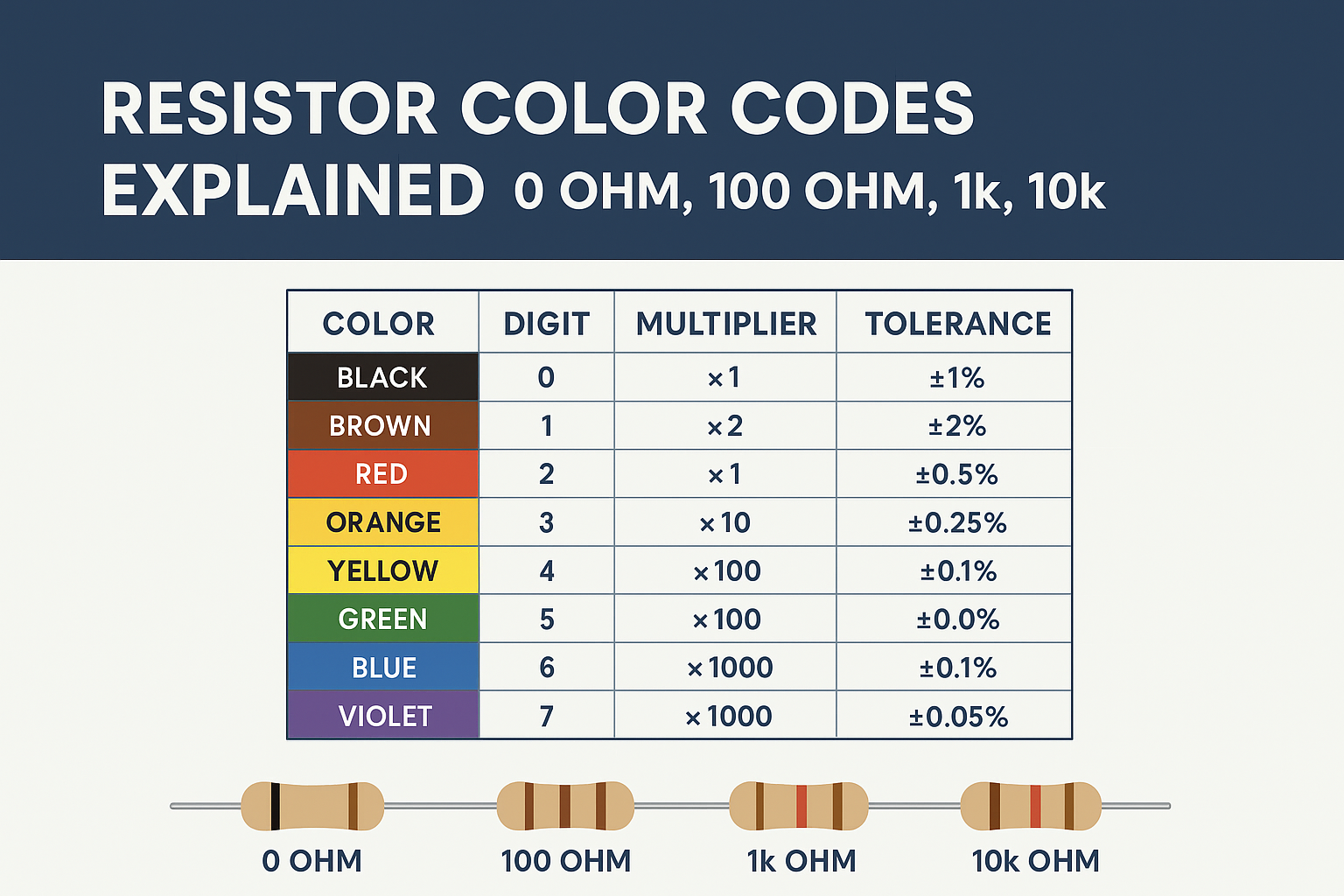
Resistor Color Codes Explained: 0 Ohm, 100 Ohm, 1k, 10k — Full Chart
Resistor color codes are a universal standard for identifying the resistance value of electronic resistors. Whether you’re working with a simple LED circuit or a professional PCB design, knowing how to read resistor color codes helps you avoid mistakes, improve accuracy, and troubleshoot circuits faster.
In this complete guide, you’ll learn how resistor color codes work, how to decode 4-band, 5-band, and 6-band resistors, and how to read common values such as 0Ω, 100Ω, 1kΩ, and 10kΩ. A full chart, tables, examples, and a helpful FAQ section are included.
Table of Contents
What Are Resistor Color Codes?
Resistor color codes are a series of colored bands printed on resistors to show their electrical resistance value. Each color represents a specific number, multiplier, and tolerance. This system allows manufacturers to label resistors even when their small size makes printing numbers impossible.
Color codes are still used worldwide because they are compact, durable, and highly reliable.
How Resistor Color Codes Work
Different resistors use different numbers of bands. The most common are:
4-Band Resistor
- Band 1: First digit
- Band 2: Second digit
- Band 3: Multiplier
- Band 4: Tolerance
5-Band Resistor
- Band 1: First digit
- Band 2: Second digit
- Band 3: Third digit
- Band 4: Multiplier
- Band 5: Tolerance
6-Band Resistor
Same as the 5-band with:
- Band 6: Temperature coefficient (ppm/K)
Full Resistor Color Code Chart
Digit, Multiplier & Tolerance Table
| Color | Digit | Multiplier | Tolerance |
|---|---|---|---|
| Black | 0 | ×1 | — |
| Brown | 1 | ×10 | ±1% |
| Red | 2 | ×100 | ±2% |
| Orange | 3 | ×1k | — |
| Yellow | 4 | ×10k | — |
| Green | 5 | ×100k | ±0.5% |
| Blue | 6 | ×1M | ±0.25% |
| Violet | 7 | ×10M | ±0.1% |
| Grey | 8 | ×100M | ±0.05% |
| White | 9 | ×1G | — |
| Gold | — | ×0.1 | ±5% |
| Silver | — | ×0.01 | ±10% |
| None | — | — | ±20% |
How to Read a Resistor (Step-by-Step Guide)
1. Identify the tolerance band
The tolerance band is usually gold, silver, brown, or red.
This band goes on the right, and you read the resistor from left to right.
2. Read the digits
For 4-band resistors: read the first two bands.
For 5-band resistors: read the first three.
3. Apply the multiplier
Multiply the digits by the multiplier color.
4. Add the tolerance
This tells you how much the resistor value may vary.
Color Codes for Common Values: 0Ω, 100Ω, 1kΩ, 10kΩ
0-Ohm Resistor
A 0-ohm resistor is not really a resistor. It acts as a PCB jumper and is coded as a single black band.
Uses:
- PCB routing
- Configuration links
- Replacing wire jumpers
100-Ohm Resistor Color Code
4-Band Color Code (100Ω ±5%)
Brown – Black – Brown – Gold
→ 10 × 10 = 100Ω
5-Band Version
Brown – Black – Black – Black – Gold
Uses:
LED limiting, signal termination, audio circuits.
1k-Ohm (1000Ω) Resistor Color Code
4-Band Code
Brown – Black – Red – Gold
→ 10 × 100 = 1kΩ
5-Band Version
Brown – Black – Black – Brown – Gold
Uses:
Pull-up/pull-down resistors, transistor base resistors, IC protection.
10k-Ohm (10,000Ω) Resistor Color Code
4-Band Code
Brown – Black – Orange – Gold
→ 10 × 1000 = 10kΩ
5-Band Version
Brown – Black – Black – Red – Gold
Uses:
Voltage dividers, sensors, potentiometers, microcontroller input resistors.
Visual Color Mapping Chart
Digit:       0     1     2     3       4       5       6       7       8       9
Color:     Black Brown  Red  Orange  Yellow  Green   Blue   Violet   Grey   White
Multipliers:
Black  ×1
Brown  ×10
Red    ×100
Orange ×1k
Yellow ×10k
Green  ×100k
Blue   ×1M
Violet ×10M
Gold   ×0.1
Silver ×0.01
4-Band vs. 5-Band vs. 6-Band Examples
100Ω
- 4-Band: Brown – Black – Brown – Gold
- 5-Band: Brown – Black – Black – Black – Gold
1kΩ
- 4-Band: Brown – Black – Red – Gold
- 5-Band: Brown – Black – Black – Brown – Gold
10kΩ
- 4-Band: Brown – Black – Orange – Gold
- 5-Band: Brown – Black – Black – Red – Gold
Common Mistakes When Reading Resistor Color Codes
1. Reading the resistor backward
Always start from the tolerance band.
2. Mixing up brown and red
Lighting and aging can make colors fade.
3. Ignoring tolerance
A 10kΩ ±20% resistor could be between 8kΩ and 12kΩ.
4. Assuming all resistors are color-coded
SMD resistors use numeric codes (e.g., 472 = 4.7kΩ).
5. Relying on old or burnt resistors
Use a multimeter if colors are faded.
Where These Resistor Values Are Used
0Ω
- Jumpers
- Ground routing
- Circuit selection links
100Ω
- LED drivers
- Audio circuits
- Data line termination
1kΩ
- Transistor biasing
- General-purpose pull-ups
- Voltage referencing
10kΩ
- Sensors
- Analog circuits
- Voltage dividers
- Logic input stabilization
How to Memorize the Color Code (Easy Method)
Color order from 0 to 9:
Black, Brown, Red, Orange, Yellow, Green, Blue, Violet, Grey, White
Mnemonic:
“Better Be Ready Or Your Great Big Venture Goes Wrong.”
FAQ — Resistor Color Codes
1. How do I read a resistor correctly?
Start at the side opposite the tolerance band.
2. What does a single-band resistor mean?
It is a 0-ohm jumper (black band).
3. What does the gold band indicate?
±5% tolerance.
4. How accurate are 1% resistors?
Very accurate, usually 5-band.
5. What does a silver band mean?
±10% tolerance.
6. Do surface-mount (SMD) resistors use color codes?
No, they use printed numbers.
7. Why do some resistors not have any color bands?
They are high-power or special-type resistors with printed labels.
8. How do I decode a 4-band resistor?
(First digit)(Second digit) × multiplier.
9. What is the most common resistor value in electronics?
10kΩ.
10. Does resistor polarity matter?
No, resistors are non-polar.
11. What if colors are damaged or burnt?
Check with a multimeter.
12. What is the temperature coefficient band?
The sixth band on precision resistors.
13. Are 5-band resistors more accurate?
Yes—usually used for 1% values.
14. Why do designers use 0-ohm resistors?
To bridge PCB traces or create selectable paths.
15. What is the E-series of resistors?
Standard grouped resistor values like E12, E24, etc.
Conclusion
Understanding resistor color codes is essential for anyone working with electrical or electronic circuits. With the charts, examples, and decoding steps provided, you can easily identify values like 100Ω, 1kΩ, and 10kΩ, whether they are 4-band, 5-band, or 6-band resistors.
Try Our Color Code Calculator
Need a quick way to double-check resistor values?
Use our Resistor Color Code Calculator — it automatically decodes 4-band, 5-band, or 6-band resistors in seconds.
Try it now »
Save time and avoid mistakes — get instant, accurate resistor values every time.