
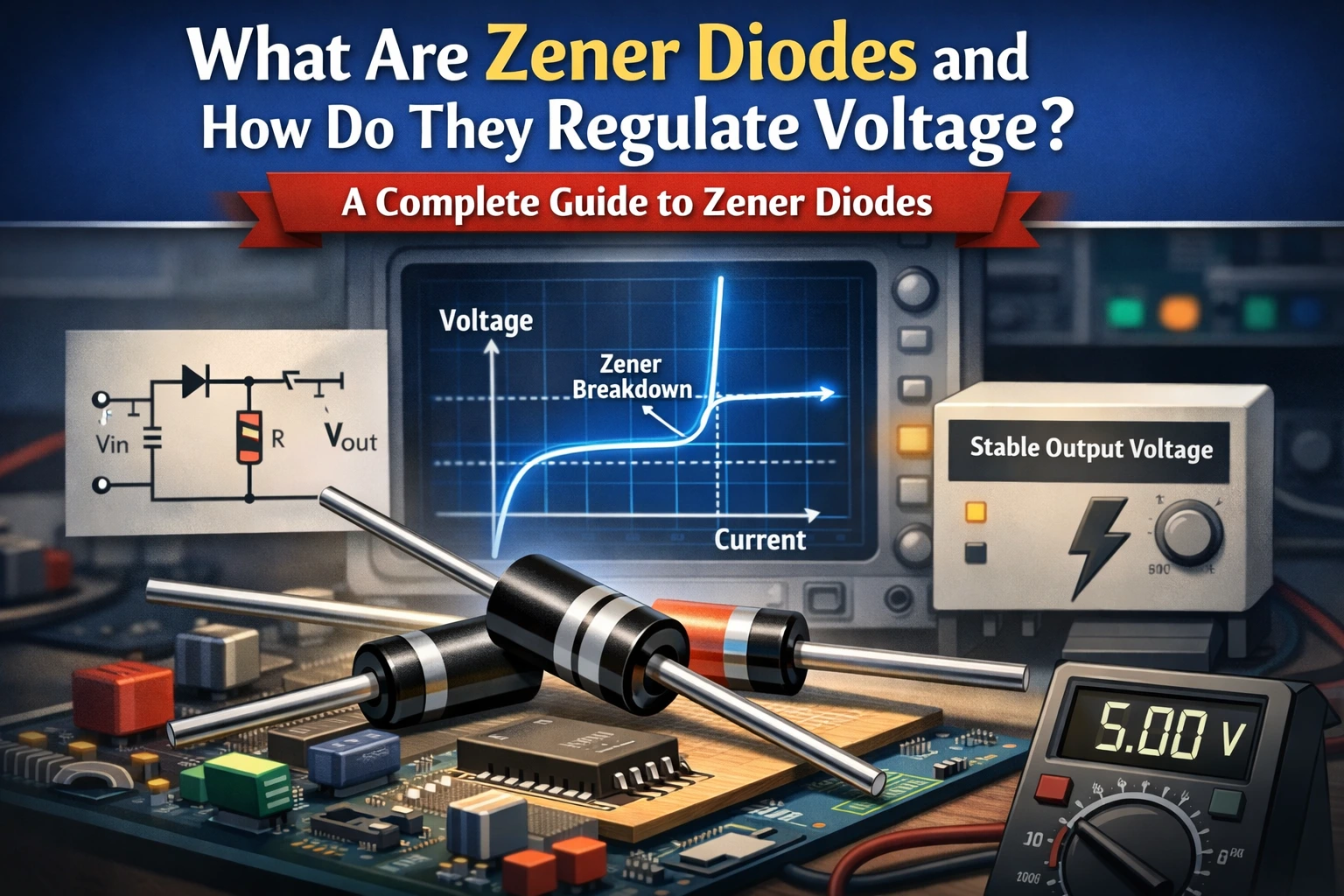
What Are Zener Diodes and How Do They Regulate Voltage? A Complete Guide to Zener Diodes
When you work with electronics—whether you are repairing a power supply, designing a circuit, or simply experimenting on a breadboard—voltage stability quickly becomes one of your biggest concerns. A small voltage spike can destroy sensitive components, while unstable power can lead to unpredictable behavior that is frustrating to diagnose. This is where Zener diodes quietly earn their reputation as one of the most dependable components in electronics.
You may not see them, but Zener diodes are constantly working behind the scenes to keep voltages under control. From consumer electronics to industrial systems, they play a crucial role in protecting circuits and ensuring consistent performance. In this guide, you will learn exactly what Zener diodes are, how they regulate voltage, and why they remain relevant even in modern electronic design.
Table of Contents
What Are Zener Diodes?
Understanding Zener Diodes in Simple Terms
A Zener diode is a special type of semiconductor diode designed to operate in reverse bias under controlled conditions. Unlike a standard diode, which blocks current in reverse bias, a Zener diode is intentionally built to allow current to flow backward once a specific voltage level is reached. This voltage is known as the Zener voltage.
When you exceed this defined voltage, the Zener diode does not fail or burn out—provided it is used correctly. Instead, it maintains a nearly constant voltage across its terminals. This predictable behavior is what makes Zener diodes so valuable in voltage regulation and protection applications.
How Zener Diodes Differ from Regular Diodes
At first glance, Zener diodes look similar to ordinary PN-junction diodes. The difference lies in how they are doped and how they behave electrically.
- A regular diode is designed to conduct only in forward bias
- A Zener diode is optimized to operate safely in reverse breakdown
- Standard diodes treat breakdown as a failure condition
- Zener diodes treat breakdown as a normal operating state
This intentional design choice allows you to use Zener diodes as voltage stabilizers, references, and protective devices.
How Zener Diodes Regulate Voltage
The Concept of Zener Breakdown
To understand how Zener diodes regulate voltage, you need to understand Zener breakdown. When a reverse voltage is applied to a Zener diode and reaches its rated Zener voltage (Vz), the electric field across the junction becomes strong enough to allow charge carriers to move freely.
Instead of a sudden destructive surge, the diode enters a controlled breakdown region where voltage remains nearly constant even as current increases. This is the key principle that allows Zener diodes to regulate voltage.
There are two physical effects involved:
- Zener effect (dominant at lower voltages, typically below 5.6V)
- Avalanche effect (dominant at higher voltages)
In practice, you do not need to worry about the physics in detail. What matters is that the diode clamps voltage to a fixed level.
How Voltage Regulation Happens in a Circuit
When you place a Zener diode in reverse bias across a load, along with a series resistor, the circuit behaves as a simple voltage regulator:
- Input voltage rises
- Excess voltage appears across the resistor
- Zener diode absorbs the surplus
- Output voltage remains stable
As long as the Zener diode operates within its current and power limits, your load sees a steady voltage, even if the input fluctuates.
Zener Diode Symbol, Construction, and Materials
Zener Diode Symbol in Circuit Diagrams
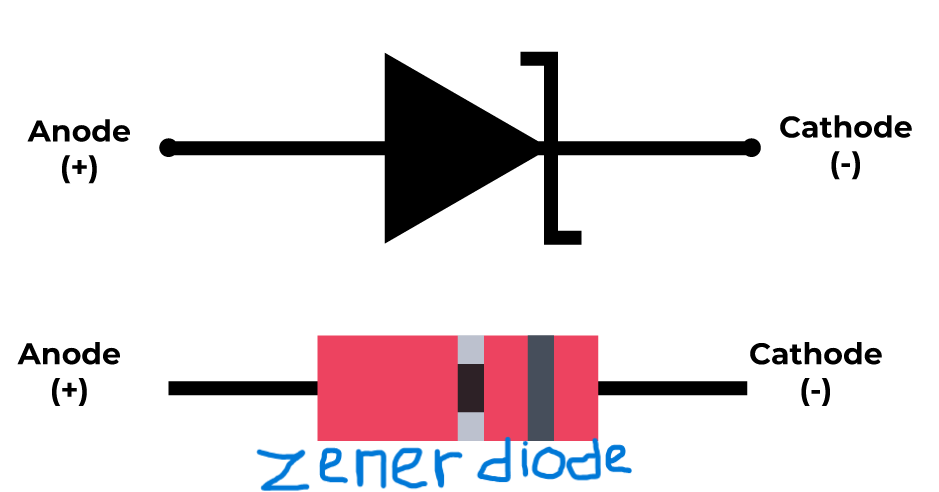
In schematics, a Zener diode symbol looks similar to a standard diode but with a bent or angled line on the cathode side. This visual distinction helps you immediately recognize that the diode is intended for voltage regulation rather than simple rectification.
Internal Construction of Zener Diodes
Zener diodes are manufactured using heavily doped silicon. This heavy doping results in:
- A narrow depletion region
- Lower breakdown voltage
- Precise control over Zener voltage
The manufacturing process is carefully controlled to ensure consistent voltage behavior across large production batches.
Materials Used in Zener Diodes
Most Zener diodes are made from silicon because it offers:
- Thermal stability
- Long operational life
- Predictable electrical characteristics
Other materials exist, but silicon dominates the market due to reliability and cost-effectiveness.
Types of Zener Diodes
Low-Voltage Zener Diodes
Low-voltage Zener diodes typically operate below 5.6 volts. In this range, the Zener effect dominates. These diodes are often used in:
- Precision voltage references
- Sensitive analog circuits
- Low-noise applications
High-Voltage Zener Diodes
High-voltage Zener diodes operate above 5.6 volts and rely primarily on avalanche breakdown. You will commonly find them in:
- Power supply regulation
- Overvoltage protection
- Industrial control circuits
Precision and Temperature-Compensated Zener Diodes
Some applications require extreme accuracy. Precision Zener diodes are designed to minimize temperature-related voltage drift, making them ideal for:
- Measurement equipment
- Calibration systems
- Instrumentation circuits
Key Zener Diode Specifications You Must Understand
Zener Voltage (Vz)
Zener voltage is the most critical specification. It defines the voltage at which the diode begins regulating. You should always select a Zener diode with a voltage rating that matches your circuit’s requirements.
Power Rating
Every Zener diode has a maximum power rating, typically expressed in watts. If the diode dissipates more power than it is rated for, it will overheat and fail. This is why proper resistor selection is essential.
Zener Resistance
Zener resistance describes how much the voltage changes as current varies. Lower resistance means better regulation and a more stable output voltage.
Temperature Coefficient
Voltage changes slightly with temperature. Precision applications require Zener diodes with low temperature coefficients to ensure stable performance across operating conditions.
Applications of Zener Diodes in Real Life
Voltage Regulation in Power Supplies
One of the most common uses of Zener diodes is simple voltage regulation. In low-current applications, they provide a cost-effective way to stabilize voltage without complex circuitry.
Overvoltage Protection
Zener diodes are widely used to protect sensitive components from voltage spikes. When voltage exceeds safe limits, the diode conducts and diverts excess energy away from critical parts.
Signal Conditioning and Voltage References
In analog circuits, stable reference voltages are essential. Zener diodes provide reliable reference points for amplifiers, comparators, and ADCs.
Meter and Instrument Protection
Measurement devices often use Zener diodes to prevent damage from accidental overvoltage, ensuring long-term reliability.
Zener Diode Voltage Regulator Circuit Explained
Basic Components of a Zener Regulator
A simple Zener regulator consists of:
- A Zener diode
- A series resistor
- A load
The resistor limits current, while the Zener diode clamps voltage.
Choosing the Right Resistor
Selecting the correct resistor value ensures:
- The Zener diode operates within its current range
- The load receives sufficient current
- Excess power is safely dissipated
Ignoring this step is one of the most common design mistakes.
Limitations of Zener Regulators
While Zener regulators are simple and reliable, they are not suitable for high-current applications. Efficiency is relatively low, and heat dissipation becomes a concern as power increases.
Advantages and Disadvantages of Zener Diodes
Advantages
- Simple and inexpensive
- Reliable voltage regulation
- Easy to integrate into circuits
- Ideal for low-power applications
Disadvantages
- Low efficiency compared to switching regulators
- Limited current handling
- Heat generation under load
Zener Diodes vs Other Voltage Regulation Methods
Zener Diodes vs Linear Regulators
Linear regulators offer better efficiency and current handling but require more components and higher cost. Zener diodes remain attractive for small, low-cost designs.
Zener Diodes vs Switching Regulators
Switching regulators are far more efficient but introduce electrical noise and complexity. Zener diodes provide a clean, noise-free solution for simple needs.
Zener Diode Selection Guide
Typical Zener Diode Characteristics
| Zener Voltage (V) | Power Rating (W) | Tolerance | Common Applications |
|---|---|---|---|
| 3.3V | 0.5W | ±5% | Logic level reference |
| 5.1V | 1W | ±2% | Microcontroller protection |
| 12V | 1W | ±5% | Power supply regulation |
| 24V | 5W | ±5% | Industrial circuits |
This table helps you quickly match Zener diodes to practical use cases.
Common Mistakes When Using Zener Diodes
Ignoring Power Dissipation
Many failures occur because designers underestimate heat. Always calculate worst-case power dissipation.
Incorrect Resistor Selection
A poorly chosen resistor can allow excessive current, damaging the Zener diode.
Using Zener Diodes for High-Current Loads
Zener diodes are not designed for high-power regulation. For demanding applications, use dedicated regulators.
Frequently Asked Questions About Zener Diodes
What Are Zener Diodes Used For?
Zener diodes are used for voltage regulation, overvoltage protection, and reference voltage generation.
How Do Zener Diodes Regulate Voltage?
They maintain a constant voltage by operating in controlled reverse breakdown once the Zener voltage is reached.
Can Zener Diodes Replace Voltage Regulators?
They can replace regulators in low-power applications but are not suitable for high current or high efficiency requirements.
What Is the Difference Between a Zener Diode and a Regular Diode?
A regular diode blocks reverse current, while a Zener diode is designed to conduct in reverse at a specific voltage.
How Do You Choose the Right Zener Diode?
You select based on Zener voltage, power rating, tolerance, and temperature stability.
Conclusion: Why Zener Diodes Still Matter in Modern Electronics
Zener diodes may be simple, but their impact is significant. When you understand how they work and how to apply them correctly, you gain a powerful tool for voltage control and circuit protection. They remain a practical choice for designers who value simplicity, reliability, and cost efficiency.
If you are building, repairing, or learning electronics, mastering Zener diodes gives you a strong foundation. Apply what you have learned here, test circuits carefully, and choose components wisely.
If this guide helped you, explore more in-depth electronics articles on our site, share this resource with fellow engineers, and start applying Zener diodes confidently in your next project.