
Gas Turbine Power Plants: Working Principle and Performance Analysis
Last updated: May 10, 2026
A gas turbine power plant generates electricity by using a gas turbine to drive a generator. It operates on the principle of the Brayton cycle, where compressed air is mixed with fuel and ignited, creating a high-pressure, high-temperature gas stream that expands through a turbine to produce rotational energy. These plants are critical for grid stability due to their rapid start-up times and fuel flexibility.
Key Takeaways
- Core Principle: Gas turbine power plants convert chemical energy from fuel into mechanical energy, which then drives a generator to produce electricity.
- Brayton Cycle: The operation is based on a thermodynamic cycle involving four stages: intake/compression, combustion, expansion, and exhaust.
- Key Components: The three essential parts are the compressor, the combustor, and the turbine.
- Two Main Types: Simple-cycle plants are fast but less efficient (35-42%), ideal for meeting peak demand. Combined-cycle plants are highly efficient (over 60%) and are used for baseload power.
- Performance Metrics: Efficiency is measured by heat rate (lower is better) and power output. Performance is significantly affected by ambient temperature and altitude.
- Fuel Flexibility: Modern turbines can run on natural gas, diesel, synthetic gas, and increasingly, hydrogen blends, supporting the transition to lower-carbon energy.
- Future Trends: The future of gas turbine technology focuses on higher efficiency, greater fuel flexibility (especially hydrogen), and integration with renewable energy sources.
Table of Contents
What Exactly is a Gas Turbine Power Plant?
A gas turbine power plant is a type of power station that uses a gas-powered turbine to generate electricity. Unlike steam turbines that use boiling water, gas turbines directly use hot gases produced from combustion to spin turbine blades. Think of it as the stationary version of a jet engine, optimized not for thrust, but for turning a generator.
These facilities are a cornerstone of modern energy grids. Because they can be started and stopped in a matter of minutes, they are exceptionally good at providing power during periods of high demand, known as « peaking. » More advanced Gas Turbine Power Plants, known as combined-cycle plants, achieve very high efficiencies and can operate continuously to provide baseload power.
- Primary Role: Fast, flexible power generation.
- Who it’s for: Grid operators needing to balance supply and demand, industrial facilities requiring reliable onsite power, and regions transitioning away from coal.
- Common Mistake: Confusing gas turbines with steam turbines. Gas turbines use the direct products of combustion, while steam turbines use steam generated by an external heat source (like burning gas, coal, or nuclear fission).
How Does a Gas Turbine Power Plant Work? The Brayton Cycle Explained
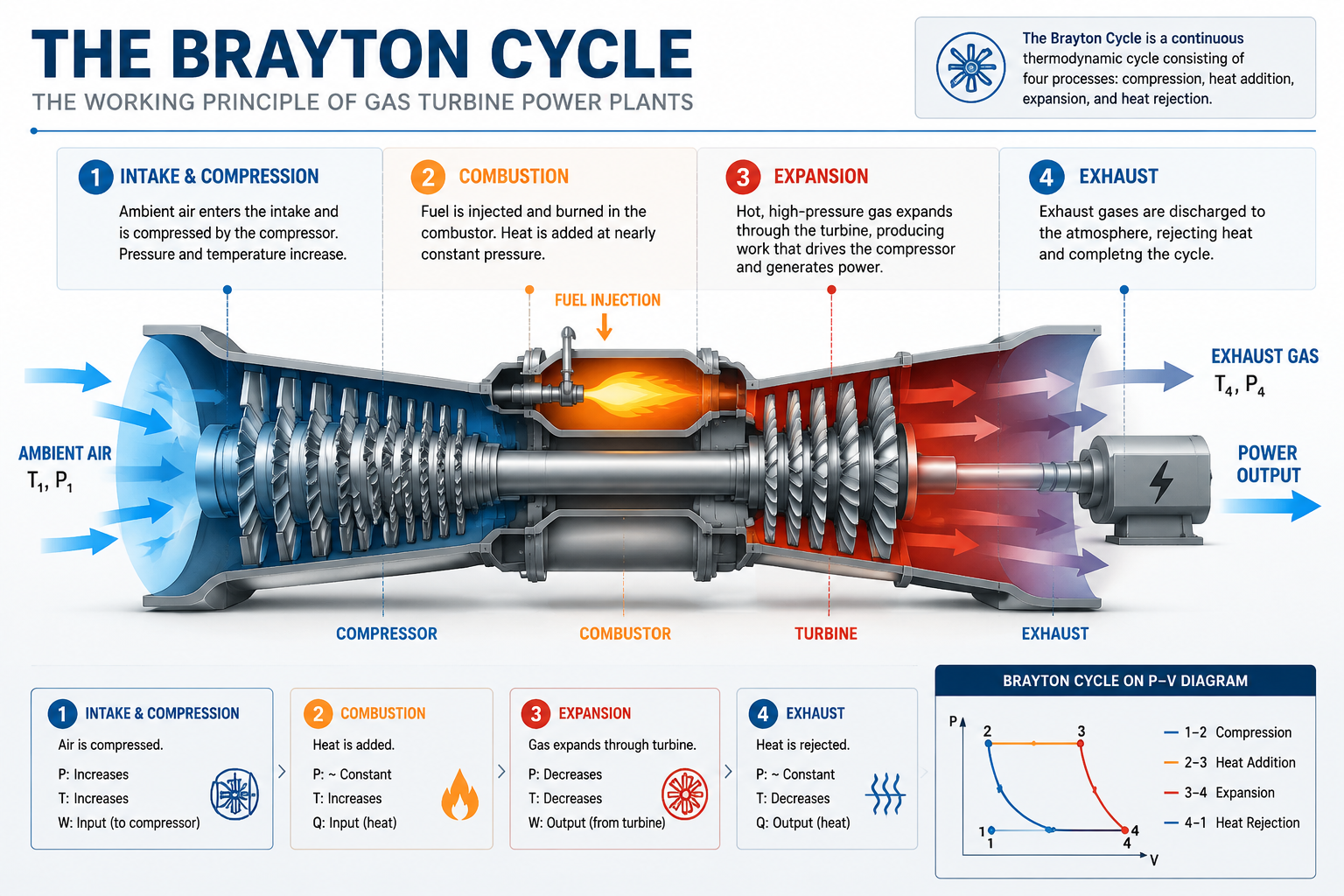
The working principle of all gas turbine power plants is the Brayton cycle, a thermodynamic process that converts heat energy into mechanical work. The cycle consists of four key stages that happen continuously within the turbine.
- Air Intake and Compression: The cycle begins as a large volume of ambient air is drawn into the turbine through an intake. This air passes through a multi-stage compressor, which consists of rows of rotating and stationary blades. Each stage slightly increases the air pressure. By the end, the air is highly compressed—typically 15 to 30 times atmospheric pressure—and its temperature has increased significantly due to the compression.
- Combustion: The highly compressed air flows into the combustor (or combustion chamber). Here, a steady stream of fuel (most commonly natural gas) is injected and mixed with the air. An igniter starts the combustion, and it becomes a continuous, self-sustaining process. This high-pressure burning process releases a massive amount of thermal energy, dramatically increasing the temperature of the gas mixture to over 1,400°C (2,550°F).
- Expansion (Power Stroke): This extremely hot, high-pressure gas is then directed at the turbine. The turbine has multiple stages of blades, much like the compressor. As the hot gas expands and cools, it pushes against the turbine blades, causing them to rotate at high speed. This is the power-producing stage, as the thermal energy of the gas is converted into rotational mechanical energy. A significant portion of this energy (often over 50%) is used to drive the compressor, while the rest is available to do useful work.
- Exhaust: After passing through the turbine, the gas, now at a lower temperature and pressure, is expelled as exhaust. In a simple-cycle plant, this hot exhaust is vented directly to the atmosphere. While it represents wasted heat, the quick completion of the cycle is what allows for rapid power generation.
What are the Main Components of a Gas Turbine?
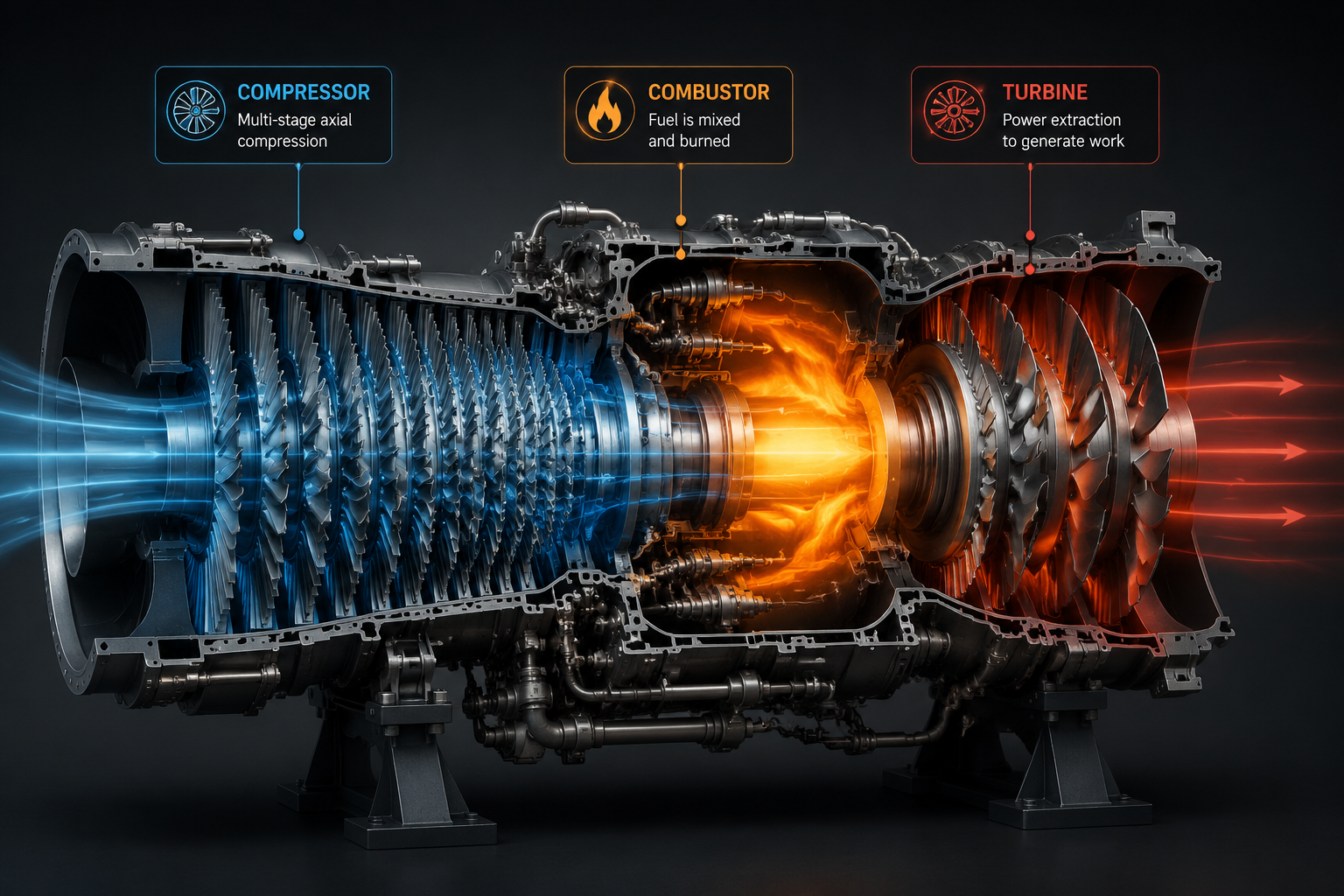
A gas turbine is a masterpiece of engineering, but its operation boils down to three critical sections that work in concert. These components are mounted on a common shaft, ensuring the power generated by the turbine section drives both the compressor and the external load (the generator).
- The Compressor: This is the first section the air encounters. It is an axial-flow compressor made up of many small airfoil blades. Its sole job is to draw in and pressurize huge quantities of air before it enters the combustor. The efficiency of the compressor is vital to the overall performance of the plant.
- The Combustor: This is where the energy is added. It’s a carefully designed chamber that continuously mixes the compressed air with fuel and burns it in a stable flame. Modern combustors are designed to maximize combustion efficiency while minimizing the formation of pollutants like nitrogen oxides (NOx).
- The Turbine: This section extracts energy from the hot gas stream. It looks similar to the compressor but works in reverse. The high-velocity gas pushes on the turbine blades, causing the entire shaft to rotate. The materials used here must be incredibly robust, often exotic superalloys, to withstand the extreme temperatures and stresses.
How is Performance Measured in Gas Turbine Power Plants?
The performance of gas turbine power plants is evaluated using several key metrics, primarily focused on efficiency and power output. These indicators help operators determine the economic viability and operational effectiveness of the plant.
The two most important metrics are heat rate and power output.
- Heat Rate: This is the most common measure of a power plant’s efficiency. It indicates how much thermal energy (in British Thermal Units or BTUs) is required to produce one kilowatt-hour (kWh) of electricity. A lower heat rate is better, as it means less fuel is needed to generate the same amount of electricity. For example, a plant with a heat rate of 6,000 BTU/kWh is more efficient than one with a rate of 10,000 BTU/kWh.
- Power Output: Measured in megawatts (MW), this is simply the amount of electrical power the plant can deliver to the grid. The output can vary based on several factors.
Key Factor: Ambient conditions have a major impact. On a cold, dense air day, a turbine can produce significantly more power than on a hot, humid day because the denser air provides more oxygen for combustion and a greater mass flow through the turbine.
Performance Analysis Table
| Metric | Description | What’s Good? | Key Influencers |
|---|---|---|---|
| Thermal Efficiency | The ratio of electrical work output to the thermal energy input from the fuel. | Higher % (e.g., >60% for CCGT) | Turbine inlet temperature, pressure ratio |
| Heat Rate | Energy input (BTU) needed per unit of output (kWh). The inverse of efficiency. | Lower value (e.g., <6,000 BTU/kWh) | Technology (simple vs. combined cycle) |
| Power Output | The net electrical power sent to the grid, measured in megawatts (MW). | Higher MW for a given frame size | Ambient air temperature, humidity, altitude |
| Ramp Rate | How quickly the plant can increase its power output, measured in MW/minute. | Higher rate (e.g., >50 MW/min) | Turbine design, operational mode |
| Availability | The percentage of time the plant is ready to operate, whether it’s running or not. | >95% | Maintenance schedule, reliability |
What are the Different Types of Gas Turbine Power Plants?
While all gas turbines operate on the Brayton cycle, they are configured into different types of power plants based on how they use the heat from the exhaust. The two primary configurations are simple-cycle and combined-cycle.
Simple-Cycle Gas Turbine (SCGT)
This is the most basic configuration. Air is compressed, combusted, and expanded through the turbine to drive a generator. The hot exhaust gas is then vented directly to the atmosphere.
- Choose this if: You need a « peaker » plant. SCGT plants are unmatched in their ability to start up in minutes and quickly respond to sudden spikes in electricity demand. Their lower capital cost and smaller footprint also make them suitable for providing emergency or backup power.
- Efficiency: 35% – 42%
Combined-Cycle Gas Turbine (CCGT)
This advanced configuration significantly boosts efficiency by using the waste heat from the gas turbine’s exhaust. Instead of being vented, the hot exhaust is channeled to a Heat Recovery Steam Generator (HRSG), which is essentially a boiler that creates steam. This steam then drives a separate steam turbine, which is connected to another generator.
- Choose this if: You need a high-efficiency baseload or intermediate-load power plant. While CCGT plants have a higher initial cost and take longer to start up than SCGT plants, their superior efficiency (often exceeding 60%) makes them far more economical for continuous or long-term operation.
- Efficiency: >60%
What are the Advantages and Disadvantages?
Gas turbine power plants play a vital role in the global energy mix, offering a unique set of benefits and drawbacks compared to other generation technologies.
Pros and Cons of Gas Turbine Power Plants
| Advantages 👍 | Disadvantages 👎 |
|---|---|
| Fast Startup & Ramping: Can go from cold to full power in minutes, ideal for grid stability. | Lower Efficiency (in Simple-Cycle): SCGT plants waste a significant amount of heat. |
| Lower Capital Costs: Cheaper and faster to build than coal, nuclear, or large hydro plants. | Fuel Price Volatility: Heavily reliant on natural gas, whose price can be volatile. |
| High Power Density: A small physical footprint can generate a large amount of power. | Sensitive to Ambient Conditions: Power output drops on hot days when demand is highest. |
| Fuel Flexibility: Can run on natural gas, diesel, biofuels, and increasingly, hydrogen blends. | NOx Emissions: High combustion temperatures can produce nitrogen oxides, requiring control systems. |
| Lower Emissions than Coal: Produces roughly half the CO2 emissions of a coal plant per MWh. | High Maintenance Costs: Components operate under extreme stress and require specialized maintenance. |
Simple Cycle vs. Combined-Cycle Plants: Which is Better?
The choice between a simple-cycle and a combined-cycle gas turbine power plant depends entirely on its intended application. One is not inherently « better » than the other; they are simply optimized for different roles within the energy grid.
- Choose Simple-Cycle for Speed and Flexibility. If the primary need is to meet peak electricity demand, provide grid stability by balancing intermittent renewables (like wind and solar), or serve as an emergency backup, the simple-cycle plant is the superior choice. Its ability to start in under 10 minutes is its defining advantage.
- Choose Combined-Cycle for Efficiency and Baseload Power. If the goal is to generate large amounts of electricity continuously and with the lowest possible fuel cost per megawatt-hour, the combined-cycle plant is the clear winner. Its high efficiency makes it ideal for running for thousands of hours per year, serving the steady, underlying demand of the grid.
In many modern energy systems, the two types work together. CCGT plants provide the bulk of steady power, while SCGT peaker plants turn on and off throughout the day to match fluctuating demand.
What is the Future of Gas Turbine Technology?
The role of Gas Turbine Power Plants is evolving rapidly in the face of the global energy transition. Instead of being phased out, the technology is adapting to become a key enabler of a low-carbon grid. The future is focused on three key areas of innovation:
- Hydrogen and Alternative Fuels: The single biggest trend is adapting gas turbines to burn low-carbon or zero-carbon fuels. Major manufacturers are already offering turbines that can burn blends of natural gas and hydrogen, with a clear roadmap toward operating on 100% hydrogen. This would allow gas plants to generate electricity with zero carbon emissions.
- Higher Efficiency and Flexibility: Engineers continue to push the boundaries of efficiency by developing advanced materials that allow for higher turbine inlet temperatures. The latest « HA-class » turbines can now reach over 64% net efficiency in combined-cycle mode. Furthermore, they are being designed to ramp up and down even faster to better support grids with high percentages of variable renewable energy.
- Digitalization and Automation: Modern gas turbine power plants are equipped with thousands of sensors that feed data into AI-powered monitoring systems. These digital twins can predict maintenance needs, optimize combustion in real-time to reduce emissions, and fine-tune performance based on weather and grid conditions, squeezing every last bit of efficiency and reliability out of the hardware.
Frequently Asked Questions (FAQ)
What is the main purpose of a gas turbine power plant?
Its main purpose is to generate electricity. Simple-cycle plants are primarily used to meet peak electricity demand due to their fast start times, while highly efficient combined-cycle plants are used to provide continuous baseload power.
How long does it take to start a gas turbine power plant?
A simple-cycle « peaker » plant can typically start and synchronize to the grid in 10 to 20 minutes. A larger, combined-cycle plant takes longer, often 1-2 hours, due to the additional steam cycle.
Is a gas turbine the same as a jet engine?
They are based on the same core technology (the Brayton cycle), but are optimized for different purposes. A jet engine is designed to produce maximum thrust to propel an aircraft, while a gas turbine in a power plant is designed to produce maximum shaft power to turn a generator.
What is the efficiency of a gas turbine power plant in 2026?
Simple-cycle plants typically have an efficiency of 35-42%. The most advanced combined-cycle gas turbine (CCGT) plants can exceed 64% net efficiency, making them the most efficient form of thermal power generation available today.
What fuel do gas turbine power plants use?
The most common fuel is natural gas due to its low cost and relatively clean combustion. However, they can also run on diesel, synthetic gases, and biofuels. Modern turbines are increasingly being designed to run on blends of hydrogen and natural gas.
Are gas turbine power plants bad for the environment?
Compared to coal-fired power plants, gas turbines are significantly cleaner, producing about half the CO2 and negligible amounts of sulfur dioxide and mercury. However, they do produce CO2 and can emit nitrogen oxides (NOx), which require modern combustion controls to minimize. Their ability to run on hydrogen in the future offers a path to zero-carbon emissions.