
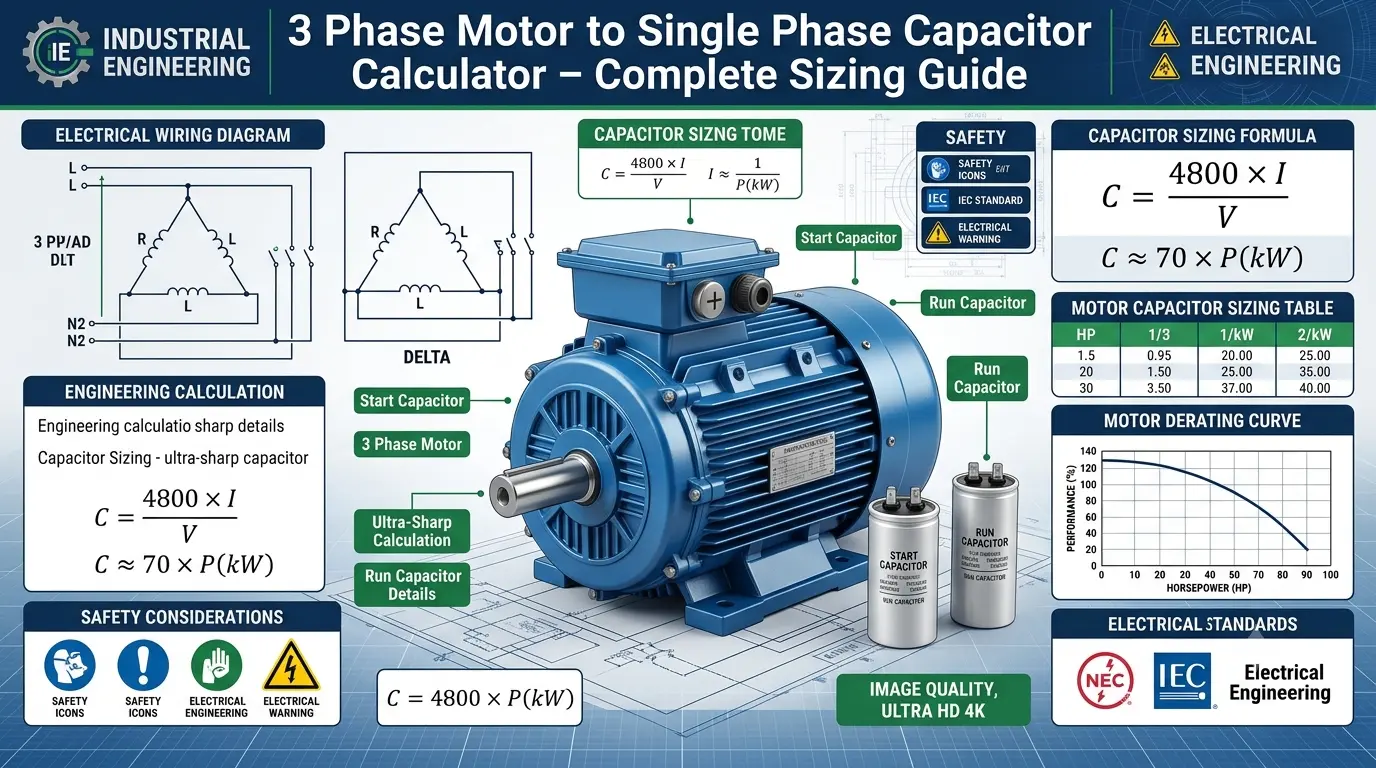
3 Phase Motor to Single Phase Capacitor Calculator – Complete Sizing Guide
Introduction
In many industrial, agricultural, and residential installations, engineers and electricians often face a common challenge: operating a 3 phase motor where only a single phase power supply is available.
Replacing the motor with a single-phase equivalent is not always economical or practical. In many cases, technicians instead use a capacitor conversion method to operate the motor from a single-phase supply. While this solution does not provide the same performance as true three-phase power, it can be highly effective for light-duty and moderate-load applications.
This guide explains everything you need to know about 3 Phase Motor to Single Phase conversion using capacitors, including:
- How the conversion works
- Capacitor sizing calculations
- Start and run capacitor selection
- Practical engineering formulas
- Wiring principles
- Efficiency considerations
- Motor derating
- Safety requirements
- NEC, IEC, and IEEE recommendations
- Real-world engineering examples
You will also learn how to use a Capacitor Calculator to determine the correct capacitor values for reliable motor operation.
Table of Contents
Understanding 3 Phase Motors
A 3 phase motor operates using three alternating currents shifted by 120 electrical degrees. This creates a rotating magnetic field that provides:
- Smooth starting torque
- Higher efficiency
- Better power factor
- Reduced vibration
- Improved reliability
Three-phase induction motors are widely used in:
- Industrial pumps
- Compressors
- HVAC systems
- Conveyor systems
- Machine tools
- Agricultural equipment
- Water treatment facilities
However, many workshops, farms, garages, and residential buildings only have access to single-phase utility power.
Can a 3 Phase Motor Run on Single Phase?
Yes — a 3 phase induction motor can operate on a single-phase supply using phase-shifting capacitors.
The capacitor creates an artificial phase displacement that helps generate a rotating magnetic field. This enables the motor to start and continue running.
However, there are limitations.
Important Limitations
Running a 3 phase motor on single phase results in:
| Parameter | True 3 Phase Supply | Single Phase with Capacitor |
|---|---|---|
| Starting Torque | High | Reduced |
| Efficiency | Higher | Lower |
| Output Power | 100% | Typically 60–80% |
| Heating | Normal | Increased |
| Current Balance | Balanced | Unbalanced |
| Reliability | Better | Reduced |
Because of these limitations, capacitor conversion is best suited for:
- Fans
- Small pumps
- Light machinery
- Drill presses
- Small air compressors
- Woodworking machines
It is generally NOT recommended for:
- Heavy industrial loads
- High starting torque applications
- Critical process equipment
- Frequent start/stop operations
How Capacitor Conversion Works
A capacitor shifts the phase angle of current flowing through one motor winding.
This creates a pseudo third phase that allows the rotor to start rotating.
Two Main Capacitor Types
1. Start Capacitor
Used only during startup to improve starting torque.
Characteristics:
- High capacitance
- Electrolytic type
- Temporary duty
- Connected through centrifugal switch or relay
2. Run Capacitor
Remains connected continuously during operation.
Characteristics:
- Lower capacitance
- Oil-filled polypropylene type
- Continuous duty
- Improves running efficiency
Basic Principle of 3 Phase to Single Phase Conversion
The motor terminals are typically connected in:
- Delta configuration
- Sometimes star configuration
The capacitor is connected between:
- Live supply
- Auxiliary winding terminal
This phase shift creates enough rotating magnetic field to sustain operation.
3 Phase Motor to Single Phase Capacitor Calculator Formula
Run Capacitor Formula
For 230V systems:
Run Capacitor (µF) = (4800 × Motor Current) ÷ VoltageAlternative approximate formula:
Capacitor (µF) = 70 × Motor Power (kW)Start Capacitor Formula
The start capacitor is usually:
Start Capacitor = 2 to 3 × Run CapacitorCapacitor Sizing Table
Typical Capacitor Values for 230V Motors
| Motor Power | Run Capacitor | Start Capacitor |
|---|---|---|
| 0.25 HP | 15–20 µF | 40–60 µF |
| 0.5 HP | 25–35 µF | 70–100 µF |
| 1 HP | 50–70 µF | 120–200 µF |
| 2 HP | 100–140 µF | 250–400 µF |
| 3 HP | 150–200 µF | 400–600 µF |
| 5 HP | 250–350 µF | 700–1000 µF |
These are approximate engineering values and may vary based on:
- Motor efficiency
- RPM
- Load type
- Frequency
- Manufacturer design
Engineering Example
Example 1 — 2 HP Motor Conversion
Given:
- Motor Power = 2 HP
- Supply Voltage = 230V
- Full Load Current = 8A
Step 1 — Calculate Run Capacitor
C = (4800 × 8) ÷ 230C = 167 µFRecommended standard value:
160–170 µFStep 2 — Calculate Start Capacitor
Start Capacitor = 2.5 × 167≈ 420 µFRecommended standard value:
400–450 µFMotor Derating Considerations
When operating on single phase power, motor output power decreases.
Typical Derating
| Original Motor Rating | Expected Single Phase Output |
|---|---|
| 1 HP | 0.6–0.8 HP |
| 2 HP | 1.2–1.6 HP |
| 5 HP | 3–4 HP |
Engineers typically assume:
Available Output ≈ 70% of Rated PowerThis is important for:
- Pump sizing
- Conveyor loading
- Compressor applications
Wiring Methods
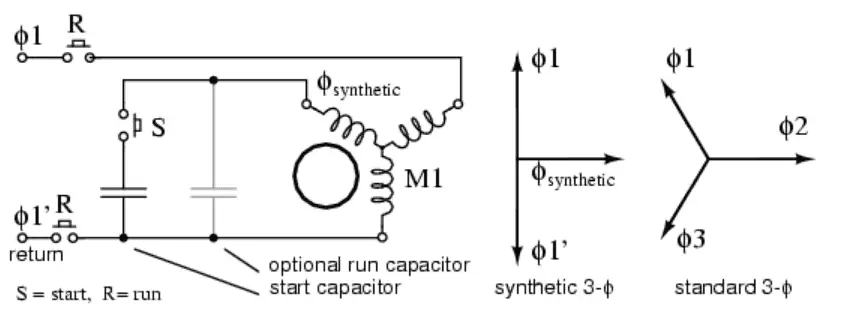
Delta Connection
Delta connection is the most common method for capacitor conversion.
Advantages:
- Better torque
- Easier starting
- Improved performance
Star Connection
Less common for single-phase operation.
Usually used for:
- High-voltage motors
- Reduced current applications
Typical Wiring Arrangement
Basic Connection
- Two motor terminals connected directly to supply
- Third terminal connected through capacitor
Components Required
- Run capacitor
- Start capacitor
- Centrifugal switch or timer relay
- Motor protection breaker
- Overload relay
Safety Considerations
Working with capacitors and motors involves dangerous voltages and stored energy.
Essential Safety Rules
1. Always Discharge Capacitors
Capacitors retain charge even after power removal.
Use:
- Resistor discharge tool
- Insulated screwdriver with resistor
2. Use Correct Voltage Ratings
Capacitors should typically be rated:
- 370V
- 440V
- 660V AC
Underrated capacitors may explode.
3. Install Proper Overload Protection
Follow:
- NEC Article 430
- IEC 60204
- IEEE motor protection guidelines
Use:
- Thermal overload relay
- MCCB or motor circuit breaker
- Fuses
4. Monitor Motor Temperature
Single-phase operation increases heating.
Install:
- Thermal sensors
- Overtemperature protection
- Ventilation systems
5. Verify Grounding
Always ensure:
- Equipment grounding
- Proper earthing resistance
- Bonding continuity
NEC, IEC, and IEEE Standards
NEC (National Electrical Code)
Relevant articles include:
- NEC Article 430 — Motors
- NEC Article 460 — Capacitors
These standards define:
- Overcurrent protection
- Disconnect sizing
- Capacitor installation rules
IEC Standards
Relevant IEC references:
- IEC 60034 — Rotating Electrical Machines
- IEC 60204 — Machine Safety
IEEE Guidance
IEEE standards focus on:
- Motor efficiency
- Power quality
- Harmonic considerations
- Thermal behavior
Advantages of Capacitor Conversion
Benefits
- Low-cost solution
- Easy implementation
- Reuse existing motor
- Suitable for remote sites
- No VFD required for basic applications
Disadvantages
Limitations
- Reduced torque
- Lower efficiency
- Increased heating
- Poor speed regulation
- Limited load capability
- Higher vibration
Capacitor Conversion vs VFD
Comparison Table
| Feature | Capacitor Method | VFD |
|---|---|---|
| Cost | Low | Higher |
| Efficiency | Moderate | High |
| Torque | Reduced | Excellent |
| Speed Control | No | Yes |
| Motor Protection | Basic | Advanced |
| Installation | Simple | Moderate |
| Reliability | Moderate | High |
When to Use a VFD Instead
A Variable Frequency Drive is usually the better option when:
- Load torque is high
- Speed control is required
- Motor exceeds 5 HP
- Frequent starts occur
- Energy efficiency matters
- Industrial reliability is critical
Common Mistakes in Motor Conversion
1. Incorrect Capacitor Size
Too small:
- Poor starting
- Low torque
Too large:
- Overheating
- Excess current
- Winding damage
2. Using DC Capacitors
Motor applications require:
- AC-rated motor run capacitors
Never use standard electrolytic DC capacitors continuously.
3. Ignoring Motor Derating
Many installers expect full power output.
This causes:
- Overload
- Thermal damage
- Reduced lifespan
4. No Overload Protection
A major safety issue.
Always install:
- Thermal relay
- Circuit breaker
- Fuse protection
5. Wrong Wiring Connection
Incorrect terminal identification can:
- Reverse rotation
- Damage windings
- Cause startup failure
Troubleshooting Guide
Motor Hums but Does Not Start
Possible causes:
- Capacitor too small
- Failed start capacitor
- Mechanical jam
- Incorrect wiring
Motor Overheats
Possible causes:
- Oversized capacitor
- Overloading
- Poor ventilation
- Voltage imbalance
Low Torque
Possible causes:
- Undersized run capacitor
- Heavy mechanical load
- Incorrect motor connection
Practical Applications
Agricultural Equipment
Commonly used for:
- Irrigation pumps
- Grain conveyors
- Feed mixers
Workshops
Used in:
- Lathes
- Drill presses
- Woodworking machines
Residential Applications
Sometimes used for:
- Garage compressors
- Small machine tools
- Hobby workshops
Power Factor Considerations
Capacitors also improve power factor.
However, improper sizing may create:
- Overcorrection
- Voltage rise
- Harmonic resonance
Engineers should verify:
- Current draw
- Voltage stability
- Thermal performance
Capacitor Types for Motor Conversion
Oil-Filled Capacitors
Advantages:
- Reliable
- Long life
- Continuous duty
Best for:
- Run capacitors
Electrolytic Capacitors
Advantages:
- High capacitance
- Compact size
Used only for:
- Short-duration starting
Selecting the Correct Capacitor Voltage
Recommended Ratings
| Supply Voltage | Recommended Capacitor Rating |
|---|---|
| 230V | 370V–440V |
| 400V | 660V |
| 480V | 660V+ |
Always provide safety margin.
FAQ Section
1. Can any 3 phase motor run on single phase?
Most squirrel cage induction motors can operate using capacitor conversion, but performance will be reduced.
2. How much power is lost during conversion?
Typically, available power drops to around 60–80% of the original motor rating.
3. Is a VFD better than a capacitor?
Yes. A VFD provides better efficiency, torque, and protection, especially for industrial applications.
4. Can I use only a run capacitor?
Yes, but starting torque may be poor. Many applications require both start and run capacitors.
5. What happens if the capacitor is oversized?
The motor may overheat, draw excessive current, and suffer winding damage.
6. What capacitor type should I use?
Use AC motor run capacitors and motor start capacitors specifically designed for motor applications.
7. Can I reverse motor direction?
Yes. Swap the capacitor connection between winding terminals.
8. Is capacitor conversion safe?
Yes, when proper protection, grounding, and capacitor ratings are used according to NEC and IEC standards.
Conclusion
Using a 3 Phase Motor to Single Phase capacitor conversion method can be a practical and economical solution where three-phase power is unavailable. By carefully selecting the correct capacitor values and following proper engineering practices, technicians and engineers can successfully operate many industrial motors on a single-phase supply.
However, capacitor conversion should always be approached with realistic expectations. Output power, efficiency, and starting torque will be lower compared to true three-phase operation. Proper capacitor sizing, overload protection, thermal monitoring, and compliance with NEC, IEC, and IEEE standards are essential for safe and reliable performance.
For demanding industrial applications, a Variable Frequency Drive remains the preferred engineering solution. But for workshops, agricultural systems, and light machinery, capacitor conversion remains a widely used and effective technique.
A properly designed Capacitor Calculator can significantly simplify the sizing process and improve installation reliability.