
Solid-State Transformer (SST): Working Principle, Advantages & Applications (2026 Guide)
Introduction
The electrical power industry is experiencing one of its biggest transformations since the widespread adoption of alternating current (AC) systems. The rapid growth of renewable energy, electric vehicles (EVs), battery energy storage systems (BESS), smart grids, and digital substations is driving demand for more intelligent and efficient power conversion technologies.
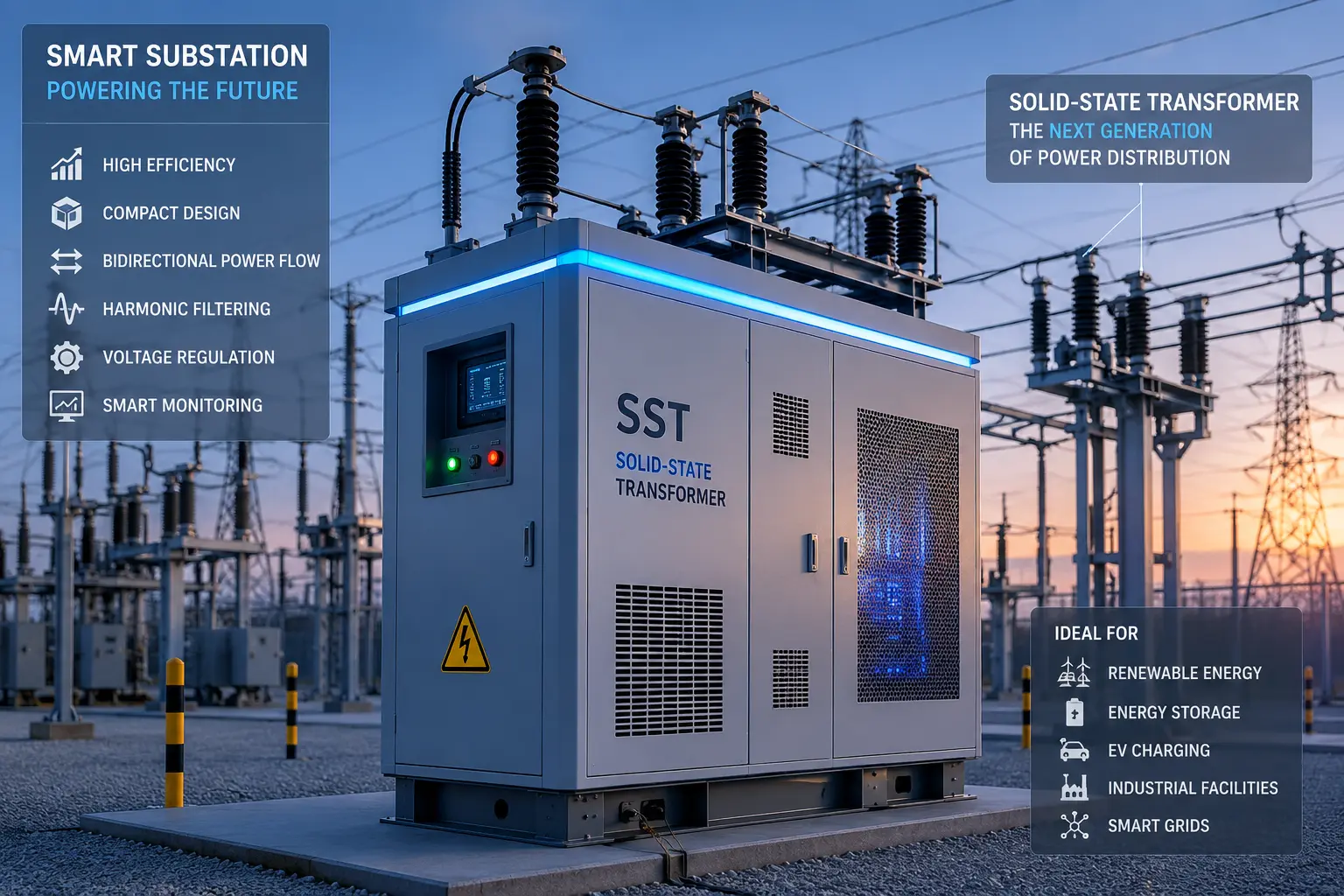
Among these innovations, the Solid-State Transformer (SST) has emerged as one of the most promising alternatives to the traditional power-frequency transformer. Unlike conventional transformers that rely solely on magnetic induction at 50 or 60 Hz, an SST combines power electronic converters, high-frequency transformers, digital controllers, and intelligent monitoring systems into a single integrated device.
A Solid-State Transformer not only performs voltage transformation but also enables voltage regulation, bidirectional power flow, reactive power compensation, harmonic filtering, fault management, and communication with modern smart grids.
Although SST technology is still more expensive than conventional transformers, continuous improvements in silicon carbide (SiC) and gallium nitride (GaN) semiconductor devices are making it increasingly practical for commercial and industrial applications.
This comprehensive guide explains the working principle of the Solid-State Transformer, its internal architecture, advantages, disadvantages, efficiency, applications, design considerations, and future developments.
Table of Contents
What Is a Solid-State Transformer?
A Solid-State Transformer (SST) is an advanced electrical transformer that uses high-frequency power electronic converters instead of relying only on magnetic coupling at mains frequency.
Unlike a conventional transformer, an SST performs several electrical functions simultaneously:
- Voltage transformation
- AC/DC conversion
- DC/AC conversion
- Frequency conversion
- Bidirectional energy flow
- Power factor correction
- Voltage stabilization
- Harmonic reduction
- Smart grid communication
Because of these capabilities, SSTs are sometimes called:
- Electronic Transformer
- Power Electronic Transformer (PET)
- Intelligent Transformer
- Smart Transformer
Instead of transferring power directly through a large 50/60 Hz magnetic core, the SST converts electrical energy into high-frequency AC before passing it through a much smaller transformer.
Why Are Solid-State Transformers Important?
Modern electrical networks are becoming increasingly decentralized.
Today’s power systems include:
- Solar photovoltaic systems
- Wind farms
- EV charging stations
- Battery storage
- DC microgrids
- Data centers
- Smart buildings
Traditional transformers were never designed to actively control power flow.
An SST acts as an intelligent energy management system capable of adapting to changing network conditions in real time.
Working Principle of a Solid-State Transformer
The operating principle of an SST can be divided into three main stages.
Stage 1 – AC to DC Conversion
Incoming AC voltage from the electrical grid is first rectified into DC using high-power semiconductor switches.
Common switching devices include:
- IGBT
- MOSFET
- Silicon Carbide (SiC) MOSFET
- Gallium Nitride (GaN) devices
During this stage, the SST can also improve:
- Power factor
- Harmonic distortion
- Voltage regulation
Stage 2 – High-Frequency DC Conversion
The DC voltage is converted into high-frequency AC.
Typical switching frequencies range from:
- 5 kHz
- 20 kHz
- 50 kHz
- Over 100 kHz for specialized systems
The high-frequency AC passes through a compact high-frequency transformer.
Because transformer size is inversely proportional to operating frequency, increasing the switching frequency dramatically reduces transformer dimensions.
Stage 3 – Output Power Conversion
After isolation, the output is converted into the required form.
Possible outputs include:
- AC
- DC
- Variable frequency AC
- Regulated DC voltage
- Bidirectional AC
The controller continuously adjusts output voltage and current according to system demand.
Internal Architecture of a Solid-State Transformer
A typical SST contains the following subsystems:
Input Converter
Converts AC into DC while correcting power factor.
DC Link
Stores electrical energy using capacitors.
High-Frequency Inverter
Creates high-frequency AC for the transformer.
High-Frequency Transformer
Provides:
- Electrical isolation
- Voltage transformation
- Compact size
Output Converter
Produces the desired output voltage and waveform.
Digital Controller
Controls:
- PWM switching
- Voltage regulation
- Current regulation
- Fault detection
- Protection functions
Main Components
An SST typically includes:
| Component | Function |
|---|---|
| AC Rectifier | Converts AC to DC |
| DC Capacitor Bank | Energy storage |
| High-frequency Inverter | Generates high-frequency AC |
| HF Transformer | Isolation and voltage conversion |
| Output Converter | Produces final output |
| Digital Signal Processor | System control |
| Voltage Sensors | Monitoring |
| Current Sensors | Protection |
| Cooling System | Heat removal |
Conventional Transformer vs Solid-State Transformer
| Feature | Conventional Transformer | Solid-State Transformer |
|---|---|---|
| Operating Frequency | 50/60 Hz | Several kHz to hundreds of kHz |
| Size | Large | Compact |
| Weight | Heavy | Much lighter |
| Voltage Regulation | Passive | Active |
| Harmonic Filtering | None | Built-in |
| Power Factor Correction | External equipment | Integrated |
| DC Output | Requires rectifier | Native capability |
| Bidirectional Power | Difficult | Easy |
| Smart Grid Compatible | Limited | Excellent |
| Communication | None | Digital |
| Fault Monitoring | Minimal | Advanced |
| Renewable Integration | Moderate | Excellent |
Working Example
Consider an industrial facility supplied with an 11 kV distribution network.
The SST performs the following operations:
- Receives 11 kV AC.
- Converts AC into DC.
- Generates high-frequency AC.
- Passes energy through a compact transformer.
- Produces:
- 400 V AC for motors
- 750 V DC for battery storage
- 800 V DC for EV chargers
A conventional transformer would require multiple additional converters to achieve the same functionality.
Transformer Efficiency
One of the major advantages of the Solid-State Transformer is its ability to optimize transformer efficiency under varying load conditions.
While conventional transformers can exceed 98% efficiency near rated load, SST efficiency depends on semiconductor switching losses, magnetic losses, and converter topology. Modern designs using silicon carbide (SiC) devices commonly achieve efficiencies above 96–98% in optimized operating ranges, while providing additional functionality such as voltage regulation, reactive power compensation, and harmonic mitigation.
Factors affecting SST efficiency include:
- Switching frequency
- Semiconductor technology
- Transformer core material
- Thermal management
- Converter topology
- Control algorithms
Although conversion stages introduce additional losses, the system-level efficiency of an SST can surpass traditional solutions by reducing the need for separate power conditioning equipment.
Advantages of Solid-State Transformers
1. Compact Size
High-frequency operation dramatically reduces transformer core size.
2. Lower Weight
Many SSTs weigh significantly less than equivalent oil-filled transformers.
3. Intelligent Voltage Regulation
The controller continuously regulates output voltage.
4. Bidirectional Power Flow
Ideal for:
- Vehicle-to-grid (V2G)
- Battery storage
- Renewable energy
5. Excellent Renewable Integration
Supports:
- Solar PV
- Wind turbines
- Battery systems
6. Improved Power Quality
Built-in capabilities include:
- Harmonic filtering
- Reactive power compensation
- Voltage stabilization
- Power factor correction
7. Digital Monitoring
Operators can remotely monitor:
- Temperature
- Voltage
- Current
- Faults
- Efficiency
- Load
8. Flexible AC and DC Distribution
An SST can supply both AC and DC loads simultaneously, making it well suited for hybrid distribution systems.
Disadvantages
Despite its advantages, SST technology has several challenges.
High Initial Cost
Wide-bandgap semiconductor devices and advanced control electronics remain relatively expensive.
Complex Control
Real-time digital control requires sophisticated algorithms and high-speed processors.
Cooling Requirements
Power electronics generate concentrated heat that requires effective thermal management.
Electromagnetic Interference (EMI)
High-frequency switching increases the need for careful electromagnetic compatibility (EMC) design.
Maintenance Expertise
Troubleshooting SSTs often requires specialized knowledge in power electronics, embedded control, and digital communications.
Applications
Smart Grids
Dynamic voltage regulation and grid support.
Electric Vehicle Fast Charging
Efficient AC/DC conversion with bidirectional charging capability.
Renewable Energy
Integration of solar, wind, and battery storage into modern distribution networks.
Railway Electrification
Voltage conversion and power quality improvement for traction systems.
Data Centers
High-efficiency power conversion with reduced equipment footprint.
Industrial Automation
Supplying variable-speed drives, robotics, and sensitive industrial equipment.
Microgrids
Supporting islanded operation and seamless synchronization with the utility grid.
Aerospace and Marine Systems
Reducing weight while improving power conversion flexibility.
Engineering Example
A manufacturing plant installs rooftop solar panels, a battery energy storage system, and several high-power EV charging stations.
With a conventional transformer, separate equipment is required for:
- Rectification
- Inverters
- Harmonic filters
- Reactive power compensation
- Voltage regulation
An SST integrates these functions into one coordinated platform, reducing installation space and improving overall energy management.
Common Mistakes
Avoid these common misconceptions:
- Assuming SSTs completely replace every conventional transformer today.
- Ignoring thermal design requirements.
- Underestimating switching losses at high frequencies.
- Neglecting electromagnetic compatibility during installation.
- Selecting inappropriate semiconductor devices for the required voltage and power level.
- Failing to coordinate protection systems with fast electronic switching.
- Overlooking cybersecurity when connecting SSTs to smart grid communication networks.
Safety Considerations
When designing, installing, or maintaining a Solid-State Transformer, safety remains critical.
- Follow lockout/tagout (LOTO) procedures before maintenance.
- Verify absence of voltage using approved test instruments.
- Wear appropriate PPE for the installation voltage level.
- Ensure proper grounding and bonding.
- Maintain adequate cooling and ventilation.
- Protect against arc flash hazards through proper risk assessment.
- Follow manufacturer commissioning procedures.
- Use insulated tools and calibrated test equipment.
- Implement surge protection where required.
- Regularly inspect cooling systems, power electronic modules, and insulation.
Standards and Industry Guidance
While no single standard fully defines every aspect of SST technology, several established standards provide guidance for design, testing, installation, and safety:
- NEC (NFPA 70) – Electrical installation requirements in the United States.
- IEC 60076 – Power transformer standards.
- IEC 61850 – Communication networks and systems for power utility automation.
- IEC 61000 – Electromagnetic compatibility (EMC).
- IEEE C57 Series – Transformer design, testing, and performance.
- IEEE 1547 – Interconnection and interoperability of distributed energy resources.
- IEEE 519 – Harmonic control in electrical power systems.
Engineers should always verify the latest editions and local regulatory requirements applicable to their jurisdiction.
Future of Solid-State Transformers
Advancements in power semiconductor technology are expected to accelerate SST adoption. Key trends include:
- Increased use of silicon carbide (SiC) and gallium nitride (GaN) devices.
- Higher switching frequencies with lower losses.
- Integration with AI-based predictive maintenance.
- Native support for DC distribution networks.
- Enhanced cybersecurity for digital substations.
- Greater deployment in renewable energy systems and EV infrastructure.
As manufacturing costs decrease and reliability improves, SSTs are likely to play a significant role in next-generation electrical distribution systems.
Frequently Asked Questions (FAQs)
1. What is a Solid-State Transformer?
A Solid-State Transformer is a power electronic transformer that combines high-frequency conversion, voltage transformation, digital control, and intelligent power management within a single system.
2. How is an SST different from a conventional transformer?
Unlike conventional transformers operating directly at 50 or 60 Hz, SSTs use power electronic converters and a high-frequency transformer, enabling active voltage regulation, bidirectional power flow, and smart grid integration.
3. Are Solid-State Transformers more efficient?
Modern SSTs can achieve very high efficiencies—often above 96% in optimized designs—while also delivering functions such as harmonic filtering and power factor correction that reduce overall system losses.
4. Where are SSTs commonly used?
They are increasingly used in EV fast charging, renewable energy integration, smart grids, industrial facilities, railway systems, microgrids, and advanced data centers.
5. Why do SSTs use high-frequency transformers?
Higher operating frequencies allow the magnetic core and windings to be significantly smaller and lighter than those in conventional 50/60 Hz transformers.
6. What semiconductor devices are used in SSTs?
Common devices include IGBTs, silicon MOSFETs, silicon carbide (SiC) MOSFETs, and gallium nitride (GaN) transistors.
7. What are the main limitations of SST technology?
Current limitations include higher upfront costs, complex control systems, demanding thermal management, and specialized maintenance requirements.
8. Will Solid-State Transformers replace conventional transformers?
Not immediately. Conventional transformers remain the preferred solution for many transmission and distribution applications due to their proven reliability and lower cost. SSTs are expected to complement and gradually expand into applications that benefit from advanced power electronic functionality.
Conclusion
The Solid-State Transformer represents a major evolution in electrical power conversion. By combining high-frequency transformation with advanced power electronics, digital control, and intelligent monitoring, SSTs provide capabilities far beyond those of conventional transformers.
Although challenges such as cost, thermal management, and system complexity remain, ongoing advances in semiconductor technology and control systems continue to improve performance and affordability. For applications involving renewable energy, EV charging, microgrids, and smart electrical infrastructure, SSTs offer significant advantages in flexibility, efficiency, and power quality.
As electrical networks become increasingly digital and decentralized, understanding the design, operation, and applications of Solid-State Transformers is becoming essential for electricians, technicians, engineers, students, and industrial professionals.